
“Hey. Can I ask you something kind of embarrassing?”
The text comes in at 9:40 on a Sunday night. The next one lands before you can type: “I’m short on rent. It’s $1,800. I’ll pay you back by March, I promise.”
Your thumb is already halfway to “Of course.”
When your adult child asks for money, the best first answer is usually neither yes nor no. It’s “not tonight, and here’s when”: take their worry seriously, say you need to check your own numbers, and set a time for a real answer. This page follows one ask from that Sunday text to the following March, because the words you choose tonight decide how March goes. Along the way you’ll get the exact lines for tonight, the replies you’re likely to hear, the one sentence to skip, the call the next evening, and what to say when the date on the promise arrives.
Sunday, 9:41 p.m.: The Two Fast Answers
Most of us answer before the screen has time to dim, and the answer comes in one of two shapes.
The first is the instant yes. “Of course. How much do you need?” It is love, and it feels like love on both ends of the phone. What your child often hears, underneath the relief, is something more practical: this door opens without a knock. Nothing bad happens that night. The money arrives, a heart emoji comes back, and you go to bed feeling like a good parent. The trouble shows up later, in small ways. The next ask comes a little sooner and a little more casually, and nobody ever talks about whether the first one cost you anything.
The second is the lecture. “Again? Where did it all go?” Every word may be fair. You may have a list, and the list may be accurate. What your child hears is a review of their year, delivered at the exact moment they felt smallest. Plenty of adults won’t ask twice after a first ask that felt like that. They find another way, and the other way can be worse: a card with a high rate, a friend they now owe, a quiet month of skipped bills. The next time they’re short, you may be the last to know.
Neither answer is the real problem; speed is. Real money gets decided in the time it takes to type four words, before anyone, including you, knows what it will cost.
Why Your Thumb Moves So Fast
Think about how money gets approved anywhere else in your life.
If a vendor you’d used for nine years sent you an invoice for $1,800, you would ask what it was for. You’d check it against the last one. You might call someone. You would not pay it from the couch at 9:41 p.m. because the email said “kind of embarrassing” in the subject line.
At home, that whole process disappears, and for a good reason: this isn’t a vendor. It’s your kid, and the part of you that answers is not the part that reads invoices. It’s the part that remembers them at six, crying over a scraped knee, and wants the crying to stop.
That instinct is not the enemy. It just shouldn’t be the one holding the phone. The goal for Sunday night is small. Answer the person now, and answer the money later. Everything below is built around that split.
Which Ask Is This One?
Not every request is the same conversation. Find yours before you pick the words.
- The first ask. Rare, a little embarrassed, a clear reason. Most of this page is written for it.
- The fourth ask this year. The pattern is the issue now, not the amount. Use the firm version, and read the March section closely.
- The real emergency. An eviction notice, a car they need for work in the morning. Waiting a day could cost more than the money. Use the version marked if it can’t wait.
- The ask with pressure. Threats, guilt that won’t let up, money leaving your account without your yes. That isn’t a script problem. Go to the section on pressure near the end.
The Words for Tonight
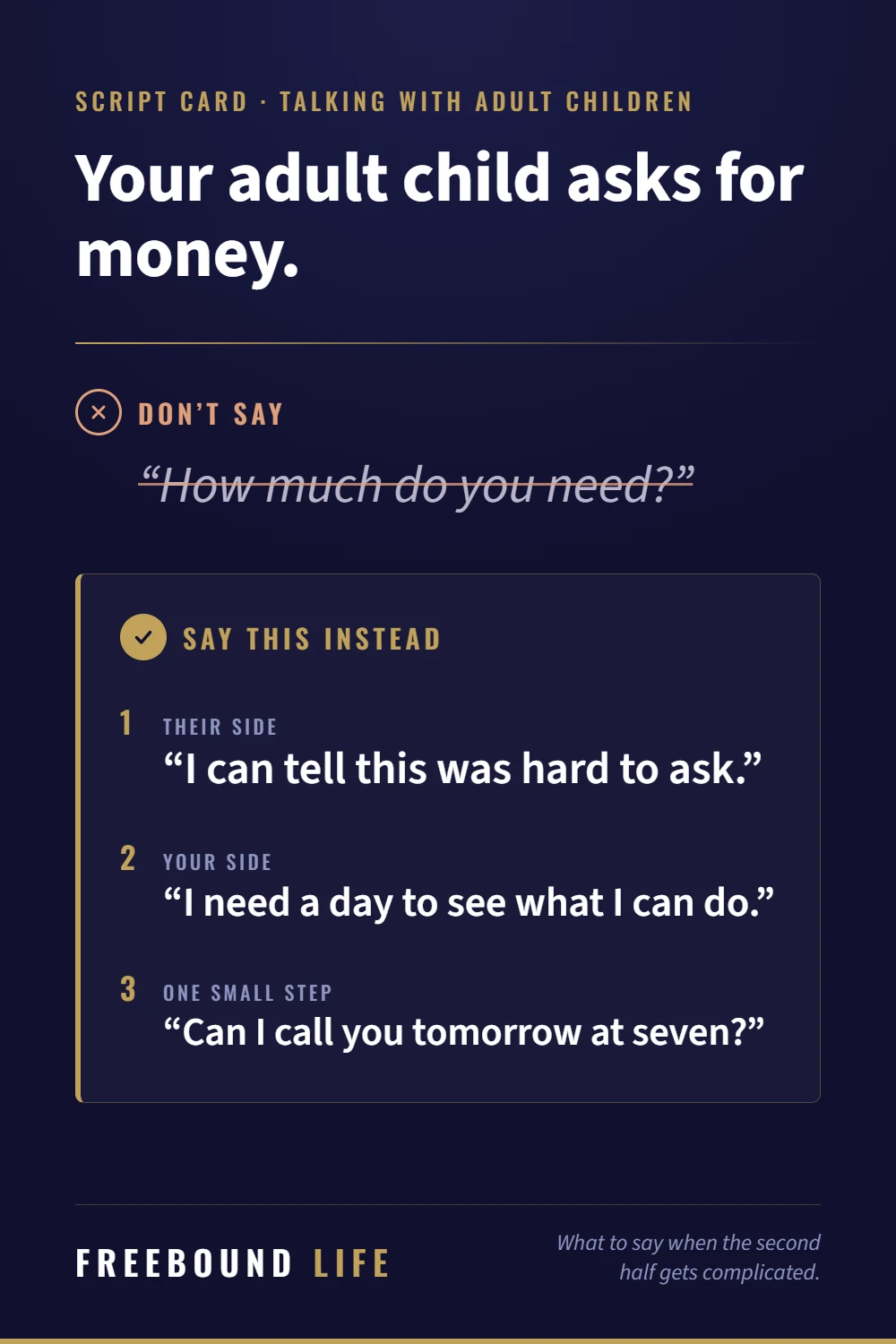
Each version below has three sentences in the same order. The first names what your child is dealing with. The second says what you need, with no blame in it. The third offers one small, concrete next step. On this site that order is called The Three-Sentence Rule, and the order matters more than the exact wording. Pick the version that sounds like you.
Soft, for a first ask or a child who has handled money well before:
“I can tell this was hard to ask, and I’m glad you came to me.”
“I need a day to see what I can do without hurting my own plans.”
“Can I call you tomorrow at seven?”
Firm, for when the answer is already no, or the asks have started arriving on a schedule:
“You’re in a real squeeze, and I’m not taking that lightly.”
“I can’t send $1,800 this time, because that money is my retirement.”
“I can sit down with you Saturday and go through the month together.”
With a smile, for a relationship that can hold a little lightness:
“You’ve clearly had a rough month, and you came to me, which I love.”
“My bank account would like a seat at this meeting too.”
“Give me until tomorrow, and I’ll call you with a real number.”
If it can’t wait, when the bill is due before tomorrow evening:
“That’s due fast, and I’m not going to leave you stuck.”
“I can cover this one bill, and I’ll pay it directly.”
“Then let’s talk Saturday about next month, before it’s due.”
“But if I make my kid wait a day, they’ll think I don’t trust them.” That’s partly true. A day feels long at 9:40 p.m., and some children will read any pause as a no. That’s exactly why the first sentence is about them and not about the money. It tells your child they aren’t in trouble before it tells them anything else. A pause that starts with “I’m glad you came to me” reads very differently from a pause that starts with silence. And when a day really is too long, the fourth version is there for that.
Sunday, 9:46 p.m.: What Comes Back on Your Phone
You send the soft version. The dots appear, disappear, appear again. Here is what tends to come back, and an answer for each that doesn’t raise the temperature.
“So that’s a no?”
“It’s a not-tonight. Tomorrow you get a real answer instead of a rushed one.”
“You helped my brother with his car.”
“I did, and I’m not comparing you two. Tell me what this month actually looks like.”
“I’ll pay you back. I swear.”
“I believe you mean it. If we do this as a loan, let’s write the date down so neither of us has to remember it.”
“Forget it. I’ll figure it out.”
“I hope you’ll still let me help with the figuring. Seven tomorrow is still on.”
And sometimes nothing comes back at all. The dots stop, and the phone goes quiet. Leave it quiet tonight. Don’t send a second message explaining the first one; that usually turns into the lecture you were trying to skip. In the morning, one short line is enough: “Still on for seven? I want to hear the whole thing.”
Each reply keeps the heat where it was and steers back to the next small step, which is where the conversation was heading before the comeback arrived.
The Sentence to Skip
“After everything we’ve done for you.”
It’s tempting because it’s usually true. You may have paid for braces, a first car, two moves and a semester that didn’t count. But your child won’t hear the history. They’ll hear a bill for their childhood, and a talk about rent becomes a talk about whether they’ve been grateful enough. Nobody wins that one at 9:40 on a Sunday night, and it tends to get replayed for years.
Monday, 7:00 p.m.: What to Decide Before You Dial
The call is easier than the text for two plain reasons. Your child has had a night to settle down, and the first thing they heard from you was that they matter. So now the conversation can be about numbers.
Before you dial, pick one of three honest answers. Decide it alone, before the call, so you aren’t deciding it while someone you love is on the line.
- A gift. An amount you could live with never seeing again. If being repaid would change how you feel about them, it was a gift all along, so call it one out loud.
- A loan, in writing. The amount, the date, and what happens if the date slips, on one page you both sign. It feels formal. It’s also kinder than a vague promise that sours by spring.
- Help that isn’t cash. An evening going through their budget, or one bill paid directly instead of money sent.
“Writing it down feels like treating my own kid like a bank.” Half of that is right: a signed page is a formal thing to bring to your child. The other half is that a bank is the one place nobody has to guess what was agreed. The page isn’t there because you don’t trust them. It’s there so neither of you has to rely on memory in March, when both of you will remember it slightly differently.
Monday, 7:04 p.m.: The Call Itself
Here’s how the call can go when you’ve picked the loan. Notice that it opens with their side, the same as the text did.
“Thanks for picking up. I’ve been thinking about you since last night.”
“Yeah. Sorry about the texts.”
“Don’t be. Walk me through the month. Not to grade it. I just want the whole picture.”
This is where a lot of calls turn, because the whole picture isn’t always the rent. Sometimes the rent is just the bill that happened to be due. Something else ate the money first: a repair, a medical bill, a gap between jobs, a payment that bounced. Let them tell it without interrupting. You will want to ask “Why didn’t you tell me sooner?” Hold that one. It’s a fair question with a bad time slot.
Then say the decision in the same three-part order.
“That’s a rough run of luck, and you handled more of it than I knew.”
“I can lend you the $1,800. My retirement needs it back by March.”
“Let’s put the date on one page this week, and we’re done.”
If you picked the gift, the second sentence changes: “This one’s a gift. I don’t want it back, and I don’t want us keeping track.” If you picked help that isn’t cash: “I can’t send money this time. I can come over Saturday morning and we’ll find next month’s rent together.”
Whichever you chose, stop talking after the third sentence. The silence after a clear answer feels long. It’s usually your child doing the math on what you just offered.
Saturday, 10:00 a.m.: The Budget Morning
If Saturday is part of the plan, bring coffee and leave the commentary at home.
Open with their side again: “I’m not here to grade anything. I’m here to help you find where it’s going.” Then let them drive the laptop. The fastest way to end a budget morning is to grab the mouse.
You will both find things. Somewhere in their statements there will be at least one subscription nobody remembers signing up for. There is a decent chance you pay for the same one, and that you also forgot. Say so. It’s the cheapest way to make the morning feel like two adults looking at a spreadsheet instead of a parent reviewing a report card.
What you’re looking for isn’t blame. It’s one change they choose themselves and one date to check in. “Which one of these do you want to cut first?” works better than any cut you suggest, because the one they pick is the one that actually happens.
March: The Date on the Page
Here’s the payoff of the decision you made before Monday’s call. March arrives either way. What it feels like depends on whether you wrote down what you agreed.
If the money comes back on time, say thank you plainly and say nothing else. No “See, that wasn’t so hard.” A clean finish is what makes the next hard conversation easier for both of you.
If the date slips, don’t wait for them to bring it up. Use the same three sentences: “I know March got away from you. I need to plan around that money. What can you do this month, even if it’s small?”
And if you realize, somewhere around the second missed date, that you never really needed it back, you’re allowed to change your mind out loud. “I’m turning the rest into a gift. Not because you failed. Because I decided.” That last sentence matters. A gift you chose sits very differently from a debt you quietly gave up on, for both of you.
What Parents Report After They Help
You are far from the only parent getting this text. In a Pew Research Center survey published in January 2024, 59% of parents with children ages 18 to 34 said they had given a child financial help in the past year, and 17% of adults ages 18 to 34 said their parents had helped with rent or a mortgage. Among the parents who helped, 36% said it had hurt their own finances at least some. Among lower-income parents who helped, 49% said so. Pew stopped asking at 34. The texts don’t.
For the grown child, help itself doesn’t look like the problem. In a 2012 study in the Journal of Marriage and Family, Karen Fingerman and colleagues found that grown children who received intense support from their parents, meaning several kinds of help many times a week, reported better psychological adjustment and life satisfaction than those who did not. The parents’ side looked different. Parents who saw their grown children as needing too much support reported poorer life satisfaction. The study measured how people felt, not what caused what.
If you have ever opened your banking app in the middle of one of these calls, the way some people open the fridge when they aren’t hungry, you know which half of that finding worries you.
My reading of both studies is this. The risk worth guarding against is helping past your own limit, quietly, until the help turns into a private tally. That’s what the second sentence in every version on this page is for. Once you’ve said “my retirement” out loud, you can help without keeping a ledger in your head.
Pressure Is a Different Problem
Everything above assumes two people who love each other and a hard conversation. If the asking comes with threats, if you feel afraid to say no, or if money leaves your account without your yes, you don’t need a better script. If you are in danger, call 911. To find help near you, the Eldercare Locator, a public service of the federal Administration for Community Living, takes calls at 1-800-677-1116.
This page is general information, not financial advice for your situation.
Other Questions Parents Ask
Should parents give money to adult children?
Many do. The useful test is personal: could you give this amount without resenting it later, and without touching money you will need? If not, a smaller amount or help that isn’t cash still counts as help.
How do you say no to your adult child?
Give one reason, not five. A long explanation invites a debate over each point; one plain reason (“that money is my retirement”) is hard to argue with. Offer something you can do in the same breath.
What to do when adult children keep asking for money?
Talk about the pattern on a day when nobody is asking. Agree on something you can keep up: a set amount with an end date, one written loan at a time, or a standing evening on the budget. If pressure or threats come with the requests, treat it as a safety issue.
One Sentence to Carry
Every answer on this page starts the same way, before a single number comes up.
Your child should hear that they matter to you before they hear what you can afford.
If you already said yes and wish you hadn’t, tell me how the ask was worded. The Ask Ian page takes it exactly as it came.
Get The Midlife Reinvention Blueprint
The free 20-page workbook for redesigning your career, money, and purpose after 40 — the four-pillar framework, a personal audit, the five defining questions, and a 90-day roadmap, including the worksheets for your freedom and coast numbers.
Read next → My Retired Husband Is Home All the Time: What to Say Instead
Most of the frameworks here come with a scored instrument: a worksheet you fill in rather than read. Reading one is quick. Filling one in is the part that changes something.
Open the pack →