A former colleague called. For ten seconds, I expected it to be urgent.
That is the whole event, and I would not normally write about a phone call. I am writing about this one because it came after I had retired, after about thirty years in finance, and those ten seconds showed me something I had not expected to still be carrying: the job’s sense of time, running on its own after the job itself had ended.
If you have left a long career, or you are close to it, some version of those ten seconds is probably waiting for you. This piece is about what they are made of, why they last longer than the work does, and what happens to them in the end.
Nine Fifteen
The phone was not the only time it happened. Another time, it was a clock.
One morning after retirement, I looked at the clock and it said 9:15. For thirty years, that number meant something. Suddenly it didn’t.
It does not matter what 9:15 used to be. Every long career has a handful of these times, and yours are different from mine. For some people it is the hour a weekly number lands, for others the last working day of the month, or the minute before a particular market opens, or the evening an inbox used to go quiet enough to think. They are rarely the times anyone would list as important. They are simply the ones that happened often enough to wear a groove. What I keep coming back to is that the number arrived with its old meaning still attached, and the meaning had to be taken off it before the plain fact was left: a quarter past nine on an ordinary morning.
Here is the plain version of what I noticed. The job had left a schedule behind in me, and the schedule was still running. It ran without anyone setting it, the way a heating system keeps its old timer after a family has moved out and nobody has found the panel.
An Empty Calendar
Another morning, I looked at an empty calendar. For years that would have felt irresponsible. Now it felt expensive.
I have turned that word over many times since, because it is an odd one. Nothing about an empty day costs money, and on paper it was exactly what retirement was for. But “expensive” was the honest word, and I think I know why it came.
For thirty years I had priced my hours by what was waiting for them. An hour with something urgent in it was a valuable hour. An hour with nothing in it was an hour I was getting away with. When every hour on the screen was empty, the old pricing did what it had always done and marked them all as waste. The calendar looked like a bill for a week I had not used.
The feeling did not care that the reasoning was out of date. It never had to care before. Inside a career the pricing was usually right, and that is how it earned its place.
It is worth being clear about what this is not. It is not the shortage of time a busy working week creates, where the hours exist but the energy to decide anything in them has already been spent; that is the problem of the decision budget, and it belongs to people who are still employed. It is not the set of habits and commitments that have outlived their purpose and need to be swept out in a midlife reset; those are arrangements, and arrangements can be cancelled. What I am describing sits underneath both, in the body, and it does not cancel. Its name is plain: urgency, the habit of treating the next thing as if it might be on fire.
Ten Seconds of Arithmetic
So back to the phone, and to what those ten seconds were actually doing.
Expecting urgency is not a neutral state. It comes with arithmetic already running: who else needs to know, what has to be dropped, how long until it can be contained. Over a long career that arithmetic runs thousands of times, and it runs so often that it stops waiting to be asked.
Psychologists have a plain name for behavior that works this way. When researchers gave students at Texas A&M watches that chimed every hour and asked them to write down what they were doing and thinking, 43 percent of what people did in the larger of two studies turned out to be habits, actions repeated almost every day in the same place. During those habits, people’s thoughts were somewhere else about half the time or more. The behavior did not need the mind’s attention, because the setting supplied the cue.
That finding explains something that otherwise looks strange about leaving a job. The work stops on a known date, but most of the cues come home with you: the phone in your pocket, the clock on the kitchen wall, the calendar on the same screen you used for twenty years. Nobody hands those back on the last day, so the behavior they used to trigger keeps getting triggered, long after the reason for it has gone.
A ringing phone with a former colleague’s name on it is about as strong a cue as a working life produces. Of course the arithmetic started. The surprise is only that it took ten seconds to notice there was nothing to calculate.
I used to think urgency was a response to how important something was. I now think it was mostly a way of keeping time. The job ran in units, and each unit ended when the next urgent thing arrived: a call, a deadline, a 9:15. Remove the job and the units go with it, but the reflex to count them stays for a while, looking for something to count.
That is why the empty calendar felt expensive and why the clock felt loud. Neither one was describing the day in front of me; both were the old timekeeping, still running, with nothing left to measure.
Hourly, Then Not at All
Here is the part I can only describe from the far side.
For a long time I checked the market every hour, and then one day I realized I had stopped checking the market every hour. I never noticed when it happened.
I have tried to find the day and cannot. There is no decision I can point to. The habit did not end so much as thin, the way a path across a field disappears once nobody walks it, and by the time I looked for it, it was grass.
I find this more reassuring than any plan would have been. A lot of advice about leaving a career assumes the hard part is filling the time. The harder part, as I found it, was hearing the time at all, because the old clock was still ticking over it. The filling goes better once the ticking fades, and the fading is not something anyone can do on purpose. It happens while you are doing other things.
“That is easy to say from the far side, and I am not there yet.” That is true, and it is worth saying how far it is true. Nobody can speed the fading up by deciding to. What you can do is stop treating the ten seconds as information. When the old arithmetic starts, let it run, notice that it has nothing to work on, and put the phone down without needing it to mean anything. That does not end the habit. It just stops feeding it.
The Clock It Left Behind
There is a version of this story where the ten seconds are a loss: proof that a person was so shaped by a job that the shape stayed after the job was gone. I do not read it that way, at least not anymore.
The ten seconds were thirty years of paying attention, still in working order, waiting for a reason. They were also, I think, the last part of the career to retire. Most of a working life leaves on the final day. The clock leaves last, and quietly, sometime around the morning I stopped looking at the market, which is a date I will never know.
If you are earlier in this than I am, the practical part is short. Expect the clock. Do not argue with it, and do not take its prices as true. Let the empty day look expensive for a while, and spend it anyway, on something that has no deadline attached. The arithmetic will keep starting for a season, and then, without any announcement, it will stop.
This is the tenth stop on The Second Half Path: finding purpose after 40 → why high achievers lose purpose → the midlife reset → identity crisis after success → designing your ideal day → reinventing yourself after 50 → feeling useless after retirement → the retirement party question → what Peter Drucker understood → you are here.
Get The Midlife Reinvention Blueprint
The free 20-page workbook for redesigning your career, money, and purpose after 40 — the four-pillar framework, a personal audit, the five defining questions, and a 90-day roadmap, including the worksheets for your freedom and coast numbers.
Why This Painting
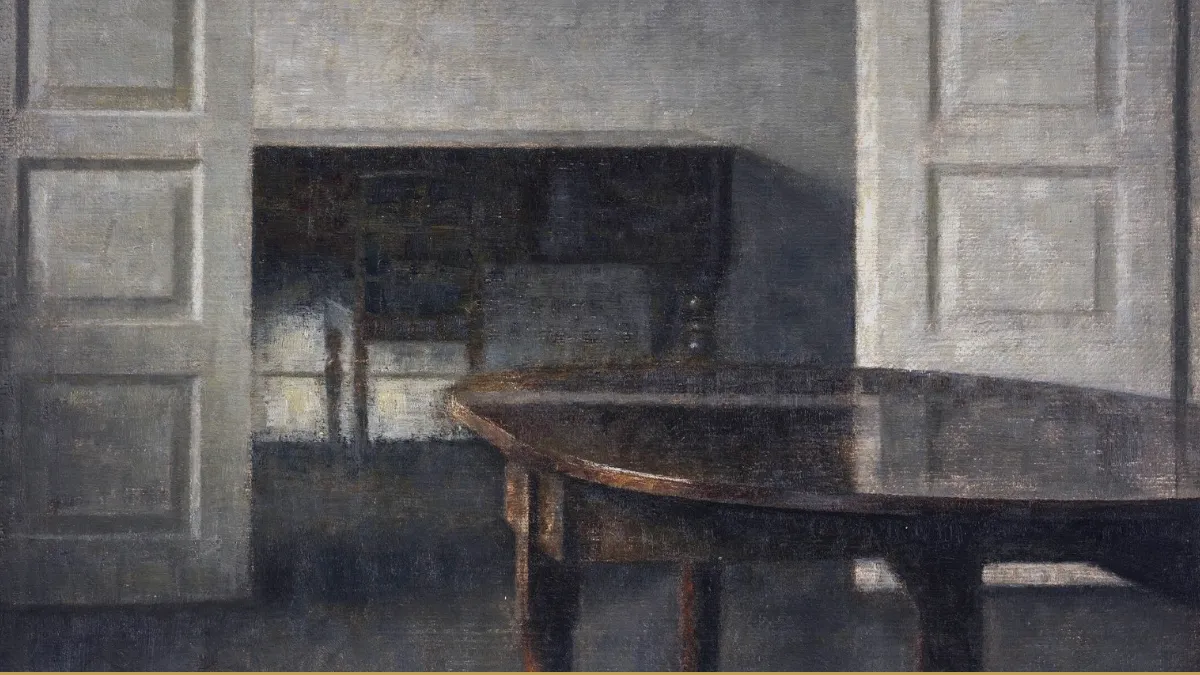
1911 is the date on this one. Vilhelm Hammershøi painted a living room with its folding doors standing open onto a back room, where a piano sits closed; the museum’s catalogue title says exactly that. A dark table fills the foreground and a framed picture hangs on the far wall. The canvas is only thirty-six centimeters high, and there is no one in it. Nothing in the room is waiting for a particular hour.
Answering the Phone
I still think about that call. I doubt the caller noticed anything at all. On my end it was the old timekeeping, running one more count.
The calls had given my days their measure, and when the calls stopped, the measuring took a while to stop too. It did stop, eventually, and the days turned out to be fine without it.
Urgency was only ever the job’s way of telling the time.
Read next → How to design a day that is actually yours
Most of the frameworks here come with a scored instrument: a worksheet you fill in rather than read. Reading one is quick. Filling one in is the part that changes something.
Open the pack →