In the first week of February 2025, I returned to Seoul.
The crisp air of late winter greeted me. But what struck me most was the energy of the city.
In Myeongdong, I saw foreign visitors exploring K-beauty stores, shopping, taking photographs, and discovering a country that had become part of the world’s cultural conversation.
In Seongsu-dong, the city’s contemporary energy offered another glimpse of how much had changed. And in Bukchon, visitors explored the quieter streets and traditional architecture, finding something distinctly Korean in a city that was becoming increasingly familiar to the rest of the world.
Seoul felt different from the city I remembered.
Yet, strangely, that difference made returning easier.
Coming back to a familiar place after a long time can leave you feeling like a stranger. You recognize the streets, the language, and the everyday rhythms. But recognition isn’t quite the same as belonging.
Watching people from around the world discover Seoul, I felt a little less disconnected. I wasn’t simply returning to a place from my past. I was arriving in a city that was still evolving, still finding new ways to connect with the world.
And perhaps I could do the same.
I had spent nearly three decades in financial services. For much of that time, work had given my days a structure and my life a clear direction.
Then, in 2025, I retired and returned to Seoul.
I had more freedom over how I spent my time. What I didn’t yet have was a clear sense of what that freedom would look like.
A Line on a Biography
I was born in Seoul and grew up in Richmond. University took me to New York, and work took me to cities across the United States and Asia: financial centers, airports, conference rooms, hotels, office towers. New projects, new responsibilities, new versions of myself. For most of my adult life I belonged wherever the work happened to be, and after a while I stopped asking where else I might belong.
In those years Seoul was mostly a reference point. A birthplace. A line on a biography. A city I visited rather than lived in.
My last day in the office and my retirement party fell on different days in early January 2025, and the party is a story of its own. What came after it was a question I had not seen coming. If work no longer decided where I lived, where did I actually want to be?
The answer came quickly, which surprised me. Seoul. In many ways it was not familiar anymore, and it was certainly not the practical choice. Something about it simply felt unfinished.
Who you are once the title has gone is a question of its own. Where you are, once nothing decides it for you, turned out to be the one waiting for me.
The City That Kept Moving
The first thing I noticed was how much had changed. Whole neighborhoods had been transformed. Buildings stood where I remembered empty spaces. The skyline seemed taller, and the pace seemed faster.
The second thing I noticed was how much had not.
For the first few months I felt local and foreign at the same time. I knew the city, but no longer by instinct. I recognized places without always recognizing the people inside them. The Seoul I remembered and the Seoul I walked through occupied the same geography and existed in different times.
Memory keeps fragments: a street corner, a shop front, the light at a certain hour. The real city kept moving for decades without asking anyone’s permission, and the version I had carried in my head was the one that had stood still. Advice can age without anyone noticing; a city ages in plain sight, and what turns out to be old is the picture you brought with you.
None of this is unusual, though nobody had warned me about it. Writing in 1980 about Americans who came home after living overseas, Sidney Werkman reported that many found it far less stressful to leave and settle in a new country than to face the unexpected jolt of coming back home. His subjects were going back to the country they had grown up in, which is not quite my story. The word that fits both is unexpected. You prepare for a foreign city; nobody prepares for the familiar one.
Afternoons Without a Destination
I spent many afternoons walking. Not for exercise, and not toward anywhere in particular.
For thirty years, movement had nearly always been attached to a purpose: meetings, appointments, flights, deadlines. The urgency had left with the job, and now the walking was the whole of it.
I began to notice things that would once have disappeared into the background. An elderly couple. The sound of rain against apartment windows. Children leaving school. The ordinary details of a city going about its afternoon, which, it turned out, it had been doing the entire time.
Back Where I Started
One afternoon I realized something I had not expected. For years I had assumed that freedom meant being able to go anywhere. When it finally arrived, it brought me back to where I started, because for once I had enough room to choose.
For most of adult life, choices are made inside constraints: career, family, responsibility, obligation. Many of those constraints are meaningful, and they still shape the choice. Retirement removed some of them, and I found myself moving toward something old rather than something new.
There is a stage of life when expansion feels important, with new places, new experiences and new opportunities. There is another stage when depth becomes more interesting than distance. Coming back to Seoul felt less like adding another chapter and more like understanding the earlier ones.
People sometimes ask whether moving back was the right decision. I don’t think of it as that kind of decision. It was a decision about identity, and its value arrives slowly, sometimes years later, sometimes never in a form anyone could measure. After thirty years in finance, that is an uncomfortable sentence to write.
Looking back, I don’t think I returned to Seoul knowing what I was looking for. I returned because I had finally reached a point where I could ask a different question. For most of my life the question had been “Where should I go next?” This time it was “Where do I want to build the next chapter?”
The two sound alike. The first is driven by opportunity; the second, by intention.
This is the twelfth stop on The Second Half Path: finding purpose after 40 → why high achievers lose purpose → the midlife reset → identity crisis after success → designing your ideal day → reinventing yourself after 50 → feeling useless after retirement → the retirement party question → what Peter Drucker understood → the call I expected to be urgent → halfway through my career advice → you are here.
Get The Midlife Reinvention Blueprint
The free 20-page workbook for redesigning your career, money, and purpose after 40 — the four-pillar framework, a personal audit, the five defining questions, and a 90-day roadmap, including the worksheets for your freedom and coast numbers.
Why This Painting
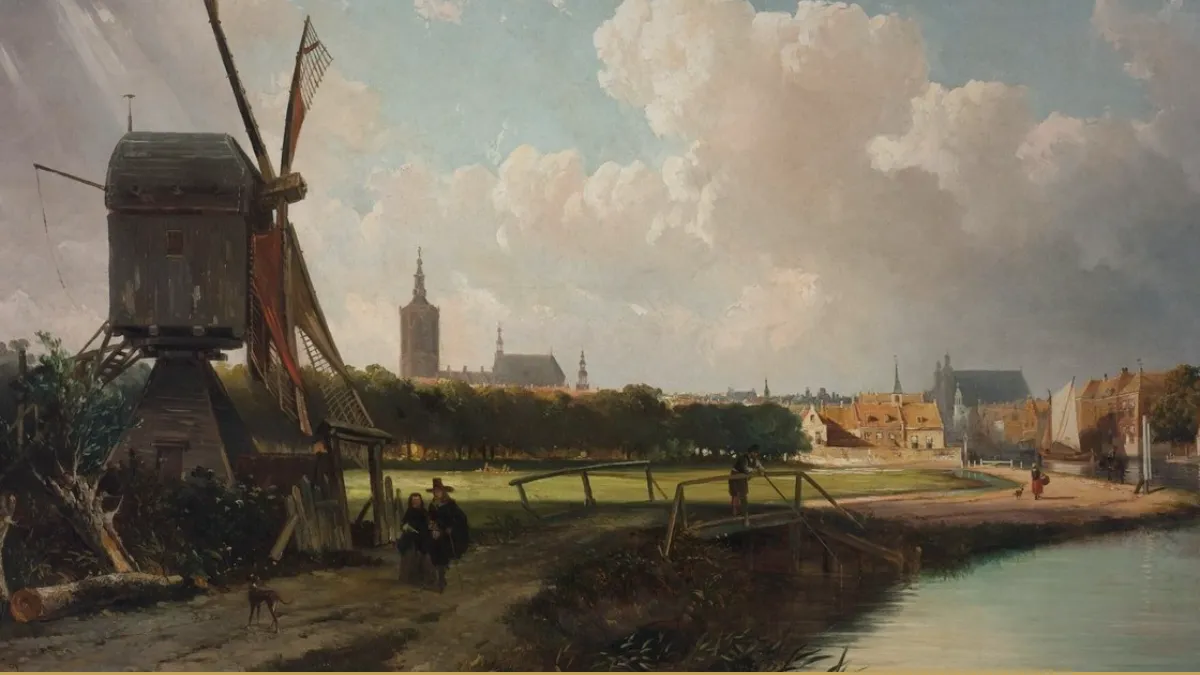
Two painters signed this canvas, Cornelis Springer and Kasparus Karsen, and dated it 1852. Its title, View of The Hague from the Delftse Vaart in the Seventeenth Century, says what they chose to paint: the city as it had looked two hundred years before them. A towpath runs past the windmill toward the towers, and a few small figures are walking it. By 1852, the town they are walking toward was already two centuries out of date.
Familiar Things, Seen Again
I had assumed that a new chapter would begin when I finally had the time to live differently.
But standing in a city that was both familiar and new, I began to see a different possibility.
Perhaps a new chapter doesn’t begin when everything becomes clear.
Perhaps it begins when you allow yourself to see familiar things differently — including yourself.
The city was changing, the world was changing, and I was beginning a different chapter of my own life.
Returning to a familiar place and finding your place in it again are two very different things.
Read next → Who you are once the title has gone
Most of the frameworks here come with a scored instrument: a worksheet you fill in rather than read. Reading one is quick. Filling one in is the part that changes something.
Open the pack →