“Are you going out? Where? When will you be back?”
It is a Tuesday, a little before eleven. He retired in March, and he has asked some version of that question every morning since. This morning, car keys in your hand, you can hear yourself about to answer in a voice you don’t like.
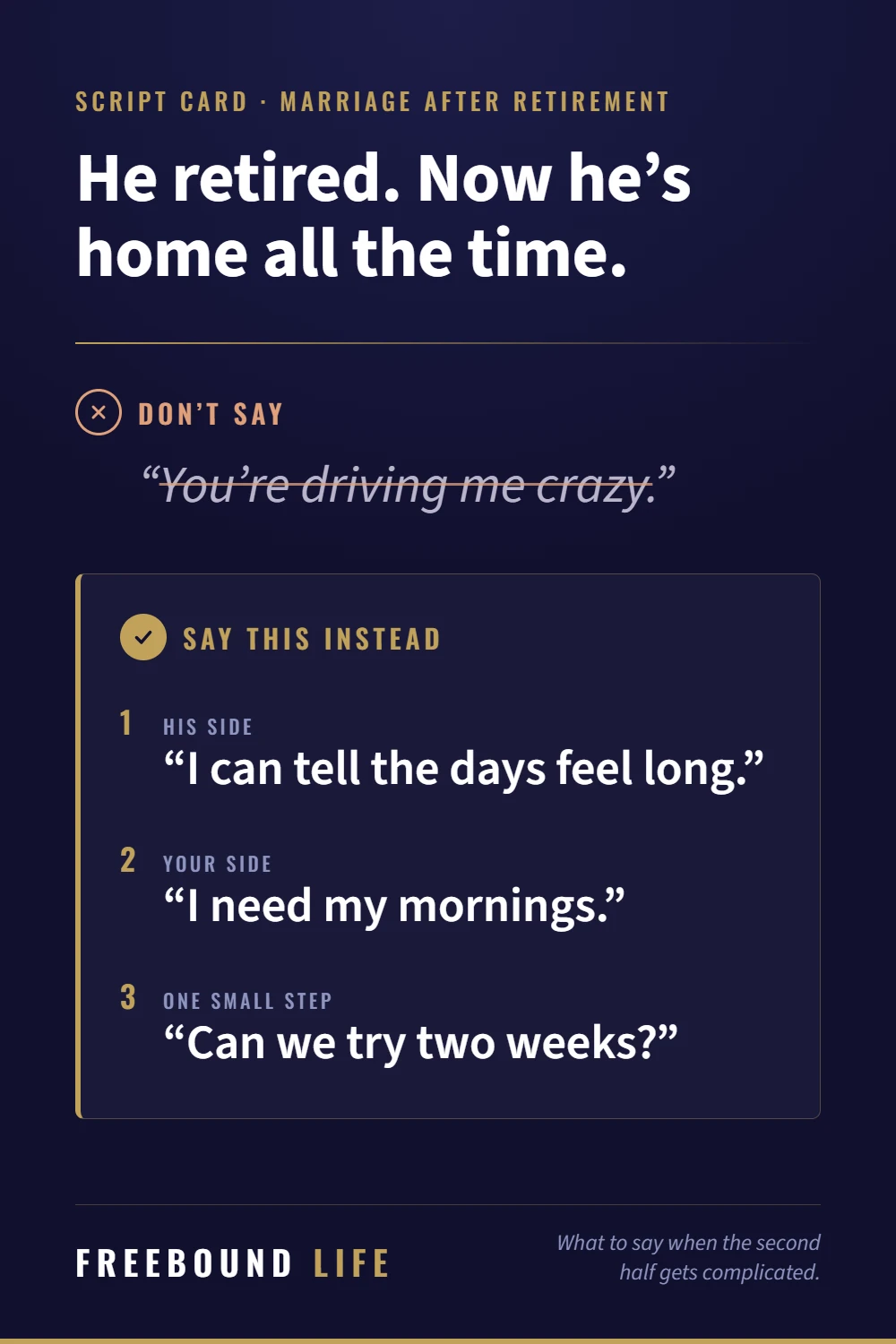
Here is the short answer, before anything else. Start with his worry, then say your need, then offer one small next step: “I know the days feel long right now. I need a few hours on my own most mornings. Can we try that for two weeks and see?”
The rest of this page is why that works, two other ways to say it, and what to answer when he pushes back.
What Usually Comes Out
Most people in this spot reach for one of three sentences.
“You’re driving me crazy.”
“Don’t you have anything to do?”
“I had a life before you retired, you know.”
Each of them is true enough to say. And each one lands the same way on a man who, a few months ago, had a calendar full of people who needed him. He doesn’t hear “I need space.” He hears “You’re in the way here too.”
That is the trap. Your first sentence ends up answering a question you never meant to raise, which is whether he is wanted at home. What you meant was smaller and fairer: you need part of the day back.
Three Ways to Open
All three follow the same order. His side first, then yours, then one small step. I call it the Three-Sentence Rule, and it is the only rule on this page.
Soft: “I can tell the days feel long since you stopped working. I need my mornings to myself for a while. Could we each plan our own mornings and meet for lunch?”
Firm: “I know this isn’t what either of us pictured. I need time alone in this house every day, or I’m going to keep snapping at you. Let’s agree on two hours each morning, starting tomorrow.”
With a smile: “You’ve reorganized the garage twice, and it was fine the first time. I love you, and I need the kitchen to myself until noon. Want to find out what the hardware store looks like on a weekday?”
Pick the one that sounds like you. The order matters more than the wording.
His Likely Replies
He may not take the first sentence well. That is fine; it is the second exchange that decides the week.
If he says, “So I’m in the way now,” try: “No. You’re home, and I’m glad you’re home. I just need part of the day to be mine, the way part of it used to be yours.”
If he says, “What am I supposed to do all morning?” try: “I don’t know yet, and I don’t think that’s mine to plan. Tell me at lunch what you found.”
If he says nothing and goes quiet for the afternoon, let it be quiet. At dinner: “I didn’t say that well this morning. The part I meant was the two hours, not the rest of it.”
None of those replies raises the temperature. That is the whole job of a reply.
Leave This One Out
“You need to find a hobby.”
It sounds practical. To a man who lost his title a few months ago, it sounds like an assignment from someone who has stopped expecting much of him. If a hobby happens, let it be his idea.
Why the Opening Sentence Carries It
This is not a sign that something is wrong with your marriage. It is a known stage. In a Cornell study of 534 married people aged 50 to 74, the newly retired reported more marital conflict than couples who had not yet retired or had been retired for more than two years. Men reported the most conflict when they had retired and their wives had not. As the lead researcher, Phyllis Moen, put it, “It’s not being retired but becoming retired” that strains a marriage (Cornell Chronicle, 2001).
The second finding is about the opening itself. The Gottman Institute, which has studied couples for decades, says the outcome of a conversation can be predicted 96% of the time from its first three minutes, and that a start built on criticism or sarcasm, which it calls a harsh startup, tends to end badly however reasonable the rest is (The Gottman Institute).
Put the two together and the practical point is simple. You are in the hardest stretch, and the first sentence is doing most of the work. Spend your effort there.
An instrument from The Three-Sentence Rule
Write your first three sentences
His side first, then yours, then one small step. The order matters more than the wording.
- You open with his side, not yours
- Each sentence fits in one breath (20 words or fewer)
- No “you always” or “you never”
- The next step has a size or a time limit
Your three sentences will appear here, in order.
One exception. If his being home has come with control, threats or fear, nothing on this page applies. That is not a conversation problem, and you deserve help from people trained for it. In the US, the National Domestic Violence Hotline answers at 1-800-799-7233, or text START to 88788 (thehotline.org).
Also Asked
How do you deal with a retired husband?
Treat it as a stage, not a verdict on the marriage. Then ask for one concrete change in the order that keeps it calm: his side first, then your need, then a small trial, such as two hours to yourself each morning for two weeks.
My husband retired and I'm still working. What should I do?
Expect this to be the bumpiest version. In the Cornell study, marital quality slumped most when only one spouse had retired, especially when the husband retired and the wife kept working. Agree early on how weekdays run now, from chores to evenings, before it turns into a scorecard.
What do I do when my retired husband follows me around the house?
Name his side before yours, then propose one small, concrete change, such as two hours to yourself each morning, for a trial period. Revisit it together at the end of the trial.
The Line to Keep
He offered to help with the groceries last week. He now has opinions about the price of eggs. Somewhere under the opinions is a man working out what he is for.
Before you ask for room, tell him he still has a place.
Did he say something this page didn't prepare you for? Send me his exact words on the Ask Ian page. You don't have to tidy them up.
Get The Midlife Reinvention Blueprint
The free 20-page workbook for redesigning your career, money, and purpose after 40 — the four-pillar framework, a personal audit, the five defining questions, and a 90-day roadmap, including the worksheets for your freedom and coast numbers.
Read next → The Last Time They Needed Me
Most of the frameworks here come with a scored instrument: a worksheet you fill in rather than read. Reading one is quick. Filling one in is the part that changes something.
Open the pack →