A younger professional asked me for career advice. Halfway through my answer, I realized I no longer believed some of it.
If you have spent twenty or thirty years in one line of work, someone has probably asked you for advice lately, and you probably gave it. This piece is about the moment that advice stops fitting the world it is being handed into, why the person giving it tends to be the last to notice, and one small habit that keeps it honest. Along the way there are two large studies of hospital doctors, published the same year, that reached opposite conclusions about what keeps experience current. The disagreement turns out to be the most useful part.
The Sentence I Was Halfway Through
Advice from a long career rarely feels like opinion to the person giving it. It feels like a report. You are describing how things work, and you have decades of evidence behind you. In my case that was about thirty years in finance, and while I was talking it felt like a very solid floor.
Then part of the floor moved. Not all of it. Some of it I still believe. But there is a particular discomfort in hearing your own voice recommend something and realizing, mid-sentence, that you can no longer vouch for it.
I am not going to list which parts. They were mine to be wrong about, and the parts that have gone stale in your advice will be different ones. What is worth looking at is the mechanism, because it works the same way for anyone who has been good at something for a long time.
Most career advice is a sentence that once worked. Stay long enough to be trusted. Get the title, and the work will follow. Never leave a gap on the CV. Each of those described some real market at some point. Each was handed on as though it were a law of nature. And each had a date attached that nobody wrote down.
That last part is the problem. A piece of advice does not announce when it was true. It arrives sounding exactly as sure of itself as the person saying it, and people who have done something for thirty years tend to sound very sure.
The person on the other side of the table is in an even weaker position to check. They came to you precisely because you have been there, and the same years that make the advice feel solid to you make it feel solid to them. They cannot see the date either. If anything, they will weigh what you say by your seniority, which is the one measure guaranteed to keep rising while the advice itself keeps getting older.
Names in the Corner Office
There is another moment I think about alongside that one.
One afternoon I realized I no longer knew the names of the people sitting in the corner office.
That is not meant to be a sad sentence. People move. Offices get reorganized. A corner office is a seat, and seats change hands. But it showed me something about how knowledge of a place wears out. It does not go all at once. The broad shape stays recognizable for years. What changes first are the details only someone inside would know: who decides now, who is new, which rule everyone has quietly stopped following.
Put plainly, the longer you are away from something, the more your picture of it describes the past. The labels change long before the landscape does, and from outside it is easy to go on reading the old labels.
Advice wears out the same way, with one difference that makes it much harder to catch. When you forget a name, you know you have forgotten it. When your advice goes out of date, it still sounds every bit as convincing as it did. If anything it sounds better, because it has been repeated and polished and confirmed by every time it worked before. It improves with retelling, which is a quality we normally reserve for fishing stories.
Two Studies, 1.4 Million Hospital Stays
Medicine is one of the few fields that measures this carefully, because there the cost of out-of-date knowledge is counted in patients.
In 2017, a team of researchers published a study in The BMJ that looked at 736,537 hospital admissions of Medicare patients aged 65 and over, treated between 2011 and 2014 by 18,854 hospitalists, the doctors who look after patients only while they are in the hospital. After adjusting for differences between patients and hospitals, patients of doctors under 40 had a 30-day mortality of 10.8%. For doctors aged 60 and over, it was 12.1%.
The authors handled that gap with care, and it deserves the same care here. The study was observational. They called the findings exploratory. They could not separate the effect of age itself from the era in which each doctor had trained, and they pointed out that physicians further from their training are less likely to follow current evidence-based guidelines. Read that way, the number says more about how knowledge ages than about any one doctor.
Then comes the detail that looks, at first, like the answer. The researchers split the doctors into thirds by how many patients they treated. Among the busiest third, those with more than 200 admissions a year, the link between age and mortality disappeared. Older doctors who were still seeing a full stream of patients did no worse than younger ones.
That would make a tidy story: stay busy and your knowledge stays fresh. The study itself warns against reading it that way, since doctors who are slipping may simply drift toward lighter caseloads. And a second study, published the same year, pulls hard in the other direction. It examined 694,020 hospital stays in Pennsylvania, across 184 hospitals and 5,280 internists and family doctors. There, a heavy recent caseload made no significant difference. What did matter was time: each decade since medical school was linked to a 4.5% higher relative risk that a patient would die in the hospital. The authors’ conclusion was not that doctors should see more patients. It was that they needed help to keep learning.
Two careful studies, one year, opposite answers about volume. I find the disagreement more useful than either result, because it separates two things that are easy to confuse. Doing something often keeps your hands practiced; it does not, on its own, tell you that the right way to do it has changed. Practice repeats what you know; updating is a separate act, and nobody does it for you.
Long experience makes you fast because you stop checking what you have already checked a hundred times. That is most of what expertise is, and most of the time it is a gift. But it has a cost that grows quietly. Experience teaches you what to notice. Given enough years, it also teaches you what to stop noticing.
Being busy does not interrupt that process; only looking again does.
The Year on the Label
Here is the plain version of the idea. Every piece of advice is accurate for the year its giver last checked it against the world.
I have started to think of that year as the advice’s vintage. It is not the year you first learned something, and it is not the last year you were busy with it. It is the last year you actually checked it against how things work now. For a doctor who read last month’s revised guidelines, that is last month. For someone who left a field ten years ago and has not looked since, it is ten years old, however vivid it still feels.
Wine carries a vintage. A carton of milk carries one too, less romantically. A piece of career advice, which someone may act on for the next ten years of their working life, carries nothing at all.
So good advice can be entirely accurate and still not fit. It was drawn carefully, by someone who walked the ground for years, and the ground has shifted since. Good advice is sometimes an accurate map of a country you no longer live in.
“Some things don’t date,” you might say. “Tell the truth. Do the work. Look after the people who look after you.” That is right, and it holds. Principles keep well. What dates is advice that applies those principles to a particular market: which door to knock on, which credential opens it, how long to wait before asking for more. And when a younger person asks for career advice, that second kind is usually what they are asking for.
This is a different problem from the defaults in your own life that quietly outlive the circumstances they were set for, the ones a midlife reset goes looking for. Those are arrangements you live inside; advice is something you hand to another person, and it leaves your hands with its vintage still unmarked. It is also different from the belief you know you have outgrown, which can be the most valuable thing you teach. That starts from a belief already replaced by a better one; the vintage problem comes earlier, before there is anything better to put in its place.
Success makes it worse in one specific way. The more senior you become, the fewer people correct you honestly, which is one of the quiet items in the hidden cost of success. So the vintage of your advice gets checked less often at exactly the stage when it is asked for more. None of this lowers the value of the experience you already own. It only means each piece of it carries a year.
This is the eleventh stop on The Second Half Path: finding purpose after 40 → why high achievers lose purpose → the midlife reset → identity crisis after success → designing your ideal day → reinventing yourself after 50 → feeling useless after retirement → the retirement party question → what Peter Drucker understood → the call I expected to be urgent → you are here.
Get The Midlife Reinvention Blueprint
The free 20-page workbook for redesigning your career, money, and purpose after 40 — the four-pillar framework, a personal audit, the five defining questions, and a 90-day roadmap, including the worksheets for your freedom and coast numbers.
Why This Painting
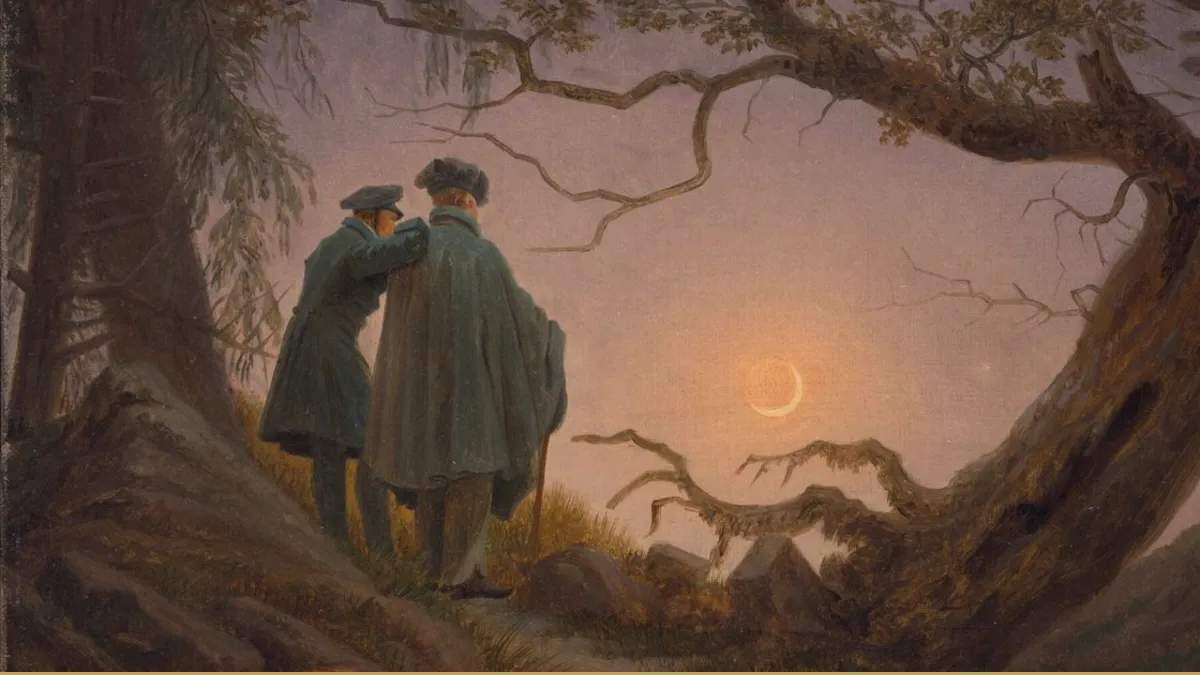
This is the third version Caspar David Friedrich painted of Two Men Contemplating the Moon; the first dates from 1819. This one, now at the Metropolitan Museum of Art, was painted around 1825 to 1830. One of the two figures is often identified as Friedrich himself, the other as his student August Heinrich, who died in 1822. If that reading is right, the painter kept returning to an evening that had already passed.
Saying the Year Out Loud
If I were answering that question again, I would change one thing. I would put the year on it.
This worked when I was close to it, and that was a while ago. Here is what I don’t know about how it works now.
That sentence costs nothing, and it does not make the advice weaker. It hands the other person what they actually need from someone older, which is a reading with its date attached, which they can then update themselves from where they stand.
And if you are the one being asked, the question to put to yourself before you answer is a short one. When did I last check this against how things work now?
Knowledge does not update itself when the world changes. It waits for you to look again.
What you know stays loyal to the last year you checked it.
Read next → How to teach what you know after 40
Most of the frameworks here come with a scored instrument: a worksheet you fill in rather than read. Reading one is quick. Filling one in is the part that changes something.
Open the pack →