
“So. I’ve been thinking about maybe slowing down at some point?”
“Slowing down how? Are you okay? Is this about the reorg?”
“No, no. Nothing’s decided. Forget I said anything.”
It is Monday, a few minutes before nine, and you have just taken eleven months of private certainty and turned it back into a rumor in fourteen seconds. You retire on March 31. Your spouse knows. The benefits office knows. The one person at work who needed to hear it now thinks you might be ill.
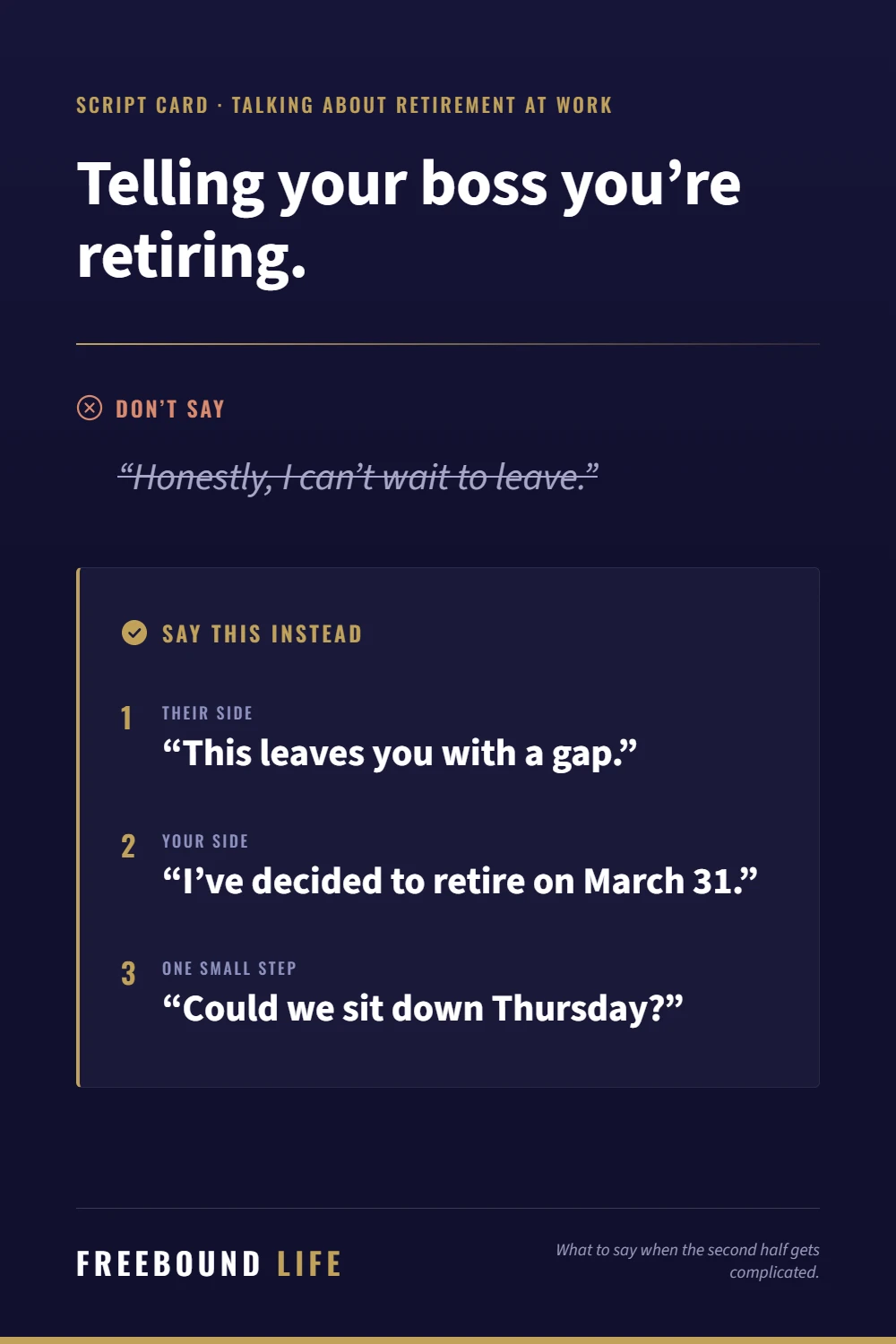
Here is the plain answer. Tell your boss in person, before anyone else at work, and open with three sentences: name the gap your leaving creates for her, say plainly that you have decided to retire and on what date, and propose one small next step, such as a meeting to plan coverage. Put it in writing afterward. Keep the reasons short.
One flat fact before the scenes: the sentence you say at nine on Monday decides how your last Friday in March goes. This page follows one announcement from the calendar invite to that afternoon.
Monday, 8:52 a.m.: The Invite Says “Quick Chat”
Rewind eight minutes, to when the meeting is still a calendar invite. There are two ways this tends to come out, and you have probably rehearsed both.
The first is the hedge you just heard. “I’ve been thinking about maybe.” It feels polite. It leaves room. What your boss hears is one of two things: “Something is wrong with you,” or “Make me an offer.”
Play it forward. By Wednesday she has asked HR whether your role could be made lighter. Or she has quietly moved you off the spring project to spare you, and you hear about it from a colleague. Either way, you now have to announce the same date twice: once to undo the rumor, and once to tell the truth.
The timing of the hedge often makes it worse. People blurt it at the end of a one-on-one, with two minutes left and her next call already ringing, or on a Friday at five, which hands her a weekend of guessing. A plain sentence needs a plain slot: early in the week, early in the day, door closed, nothing booked behind it.
The second way skips the conversation entirely. You send the letter.
“Please accept this as formal notice of my retirement, effective March 31.”
She reads it on her phone between two other meetings. What she hears is, “You didn’t trust me with this.” Her reply is polite and short.
“Thanks for letting me know. Let’s find time to talk.”
The meeting that follows opens with her hurt, and your plan waits until she is done. Plenty of people in her seat forward the letter to HR before they have said a word to you, because a letter feels like a process has already started.
The Hedge Feels Like Good Manners
The hedge comes from good habits. For thirty years you have softened hard news for clients, colleagues and the occasional regional director. Saying “I’m retiring” out loud also makes it real in a way the spreadsheet at home never did. And some part of you worries that once they know, you will stop being asked.
But look at how you behave in every other meeting you have ever run. You have sat through a hundred budget reviews. Nobody who wanted approval opened with “I don’t know, maybe, at some point.” They opened with the number. A retirement date is the number. Everything kind you want to say lands better once it has been said.
If the hedge is there because you are genuinely unsure, that is a different problem, and it deserves its own evening before it gets a meeting. The post on why the best-prepared people feel the least ready is about exactly that doubt.
Four Rooms You Might Be Walking Into
The same meeting comes in different rooms. Find yours before you pick your words.
The date is set and you want out on it. Use the firm version below, and don’t offer options you don’t mean.
You’d stay part-time if she asked. Use the soft version, and say the date first anyway. The option comes after the date, as an offer.
You have worked for the same person for twenty years. The version with a smile usually fits. She will grieve a little. Let her.
It can’t wait. A parent, your health, a spouse who needs you home. Use the last version below, and know that a date is all she needs from you today.
Monday, 9:00 a.m.: Three Sentences, Then Stop
The order matters more than the wording. Start with her side: the gap you leave, named before she has to name it. Then your side: the decision and the date, said as a decision. Then one small next step, so the meeting ends with a plan on the table. That shape is the house rule here, The Three-Sentence Rule, and it works at a desk as well as at a kitchen table.
Soft.
“This leaves you with a gap, and I know the timing isn’t great.”
“I’ve decided to retire. My last day will be March 31.”
“Could we sit down Thursday and map out who picks up what?”
Firm.
“I know this makes your spring harder.”
“I’ve decided to retire on March 31, and the date is set.”
“I’ll have a coverage plan on your desk by Thursday.”
With a smile.
“You’re about to lose the last person here who knows how the old fax machine works.”
“I’m retiring. My last day is March 31.”
“Can I buy you a coffee Thursday and walk you through my list?”
If it can’t wait.
“I know this is short notice, and it puts you in a bind.”
“For family reasons, my last day needs to be the end of next month.”
“I’ve written down everything I can, and I’d like to walk you through it today.”
Then stop talking. The pause after the third sentence belongs to her. It will feel long. It rarely is.
Two Voices That Will Tell You to Wait
Someone will give you the opposite advice, and part of it is right.
The first voice belongs to a friend who has seen this go badly. “Don’t tell them a day before you have to. They’ll take you off everything that matters.” That fear has numbers behind it. In an AARP poll of 1,656 workers aged 50 and older, published in early 2026, 64 percent reported seeing or experiencing age discrimination at work, and 22 percent felt they were being pushed out. If your workplace has already shown you how it treats people with one foot out the door, shorter notice may be the wiser call. In most offices, though, the hedge brings the sidelining anyway, without the clarity. A date said plainly is harder to quietly route around than a rumor.
The second voice belongs to the colleague who knows HR. “Just send the letter. It’s cleaner, and it’s on the record.” Also half right. A written record matters, and your benefits paperwork will need one. The letter should simply be the second thing she reads, not the first thing she hears.
Monday, 9:04 a.m.: Her First Reply
Whatever she says next, the reply that works never raises the temperature. Four replies come up a lot. Here is one you can say back to each.
“Is this about money? Because we can talk about money.”
“It isn’t, and I appreciate that you’d offer. The date is March 31.”
“Can you stay through the summer? Just until we find someone?”
“Full time, I can’t. I can make the spring easier. And if two days a week through June would help, let’s look at that Thursday.”
(Only offer the second half if you mean it.)
“Have you really thought this through?”
“For about a year. You’re the first person here I’ve told.”
“Who else knows?”
“Nobody at work. I wanted you to hear it first. How would you like the team to hear it?”
And sometimes there is no reply at all. She says, “Okay. Wow. Okay,” and the meeting is over. Tuesday passes. Wednesday morning passes. Don’t read the quiet as anger. Plenty of managers need to tell their own boss before they can say anything useful to you. On Wednesday afternoon, send one short note.
“I know Monday was a lot. I’m still glad to sit down Thursday at two, if that works.”
Thursday, 2:00 p.m.: The List on the Whiteboard
She is on time, and she has brought a marker.
“I told my director yesterday. She asked if you’d consider staying on as a consultant.”
“Not right now. Ask me again in June.”
“Fair. So what’s on your plate that nobody else can do yet?”
“Three things. The big renewal in February, the quarter-end close, and the vendors who only return my calls.”
“Who would you pick for each?”
“The two newest analysts for the close. I’d like them to run it while I watch.”
She writes it down. Then you say the next part in the same order as Monday: her side, your side, one step.
“I know the team is going to worry about the workload. I’d like to tell them myself, next Monday, with you in the room. Then we send the note to the wider group by Wednesday.”
“Deal. And put the date in writing for HR today, will you?”
“Already drafted. It’s three lines.”
It is three lines. The date, a thank-you, and an offer to help with the transition. Nothing in it argues.
Monday, Two Weeks On: The Team Hears It From You
You say it in four sentences, with your boss beside you. Somebody across the table is first to speak.
“So that’s what the closed door was about.”
“It was. I wanted you to hear it from me.”
“Who’s going to know where the spare toner lives?”
“You are. I’m leaving a map.”
The laugh is real, and then the room gets quiet, and that is real too. A teammate of fifteen years asks the question nobody else will.
“Are you okay? Like, really?”
“I’m fine. I’m ready. That’s the whole story.”
The goodbye lunch, the card, the speech at the end: those are a different conversation, with its own odd silences. The post on the question no one asked at my retirement party sits in that room.
One Line She Will Remember Wrong
There is one sentence to leave out of every one of these meetings.
“Honestly, I can’t wait to leave.”
You mean that you are ready. What she hears is, “These years were time served, including the ones with you.” If you want to say how you feel, say the true thing in its better form.
“I’m ready for what’s next.”
Her Side of the Ledger
Why open with her side at all? Because of what your announcement costs the person across the desk.
Gallup’s workplace researchers put the cost of replacing one employee at one-half to two times that person’s annual salary, and they call that a conservative estimate. In the same report, 51 percent of people who left a job said that in their last three months, no manager or other leader had talked with them about their satisfaction or their future there.
Those figures describe people leaving for other jobs. Retiring is its own kind of exit, but the arithmetic on her side of the desk is the same. Your boss loses a colleague and inherits a cost in the same minute, often with a deadline she didn’t choose. And she may be one of the many managers who never once asked you about your plans, which means your news can sound, to her, like something she missed.
So the first sentence does a specific job. “This leaves you with a gap” tells her you have already seen the cost, and that she won’t have to argue you into caring about it. After that, the date sounds like a fact the two of you are planning around together.
Last Friday in March, 4:40 p.m.: The Date Nobody Moved
The whiteboard list has a line through every item. The two newest analysts ran the close on their own on Tuesday, and you watched with your hands in your lap. The renewal signed in February.
Your boss stops by your desk with an envelope and a coffee.
“You know what made this easy?”
“The coffee?”
“You told me the date before you told me anything else. I never had to guess which parts were negotiable.”
The card inside has thirty signatures. On the front, someone has drawn the old fax machine, with a speech bubble that says “Who will understand me now?”
The date on the whiteboard is the date you said at nine o’clock on a Monday in January. It never moved, because it was never said as a question. At five, you pick up your bag, and nobody asks you to stay a little longer. That is the sentence from Monday, paid in full.
What comes after the last day, the quieter phone and the mornings with nobody waiting on you, is its own conversation. The last time they needed me is about that part. And if someone at home is about to have you there all day, the script for that kitchen is waiting too.
Notice, Paper and Retiring Early
How far in advance should I tell my employer I’m retiring?
There is no single number. The real deadlines come from your pension or retirement plan, your health coverage and how long your role takes to cover, so ask HR or your plan administrator about the paperwork before the meeting. If you work for the federal government, OPM says your agency needs a minimum of 60 days to process a retirement application, and some agencies need more. Your boss usually hears it before the paperwork goes in.
Should I tell my boss in person or in writing?
Both, in that order. The conversation comes first; the letter follows the same day or the next. Keep the letter to the date, a thank-you and an offer to help with the transition. It is a record, and nothing in it should need defending later.
How do I tell my boss I’m retiring early?
Early retirement draws more “why” questions and more worried looks. The three sentences don’t change, but have one calm line ready for the question about your health or your finances: “Everything’s fine. I’ve just decided it’s time.” You owe her the date and your help. The reasons can stay at home.
Walk In Holding This
Say the date first, and every kind sentence after it has somewhere to land.
Maybe your first sentence is still a draft on the back of an envelope. The Ask Ian page will read it before your boss does.
Get The Midlife Reinvention Blueprint
The free 20-page workbook for redesigning your career, money, and purpose after 40 — the four-pillar framework, a personal audit, the five defining questions, and a 90-day roadmap, including the worksheets for your freedom and coast numbers.
Read next → The Call I Expected to Be Urgent
Most of the frameworks here come with a scored instrument: a worksheet you fill in rather than read. Reading one is quick. Filling one in is the part that changes something.
Open the pack →