The team chat is still on your phone. It has slid about two-thirds of the way down the list, below the dentist and above a group from somebody’s wedding in 2019, and the last message in it is three weeks old. It is a photo of a birthday cake in the break room. Fourteen people reacted with a thumbs-up. You were the fifteenth, a day late.
Nobody removed you. Nobody needed to.
Losing work friends after retirement is rarely a verdict on the friendships. More often it is what happens when the calendar stops doing the inviting. For thirty years a meeting request, a shared deadline or the queue for the microwave did the asking, and nobody had to admit they wanted the company. Now somebody has to write first, and the person with the free afternoon is you. The message itself is small: their side first, then yours, then one specific day.
What you send this week decides whether, by April, this person is still someone you talk to, or just a name your phone offers when you start typing someone else’s.
Week Six, a Wednesday, 4:10 p.m.
You open the chat because it is there. Someone is asking whether the new expense system has a mobile app. Someone else answers with a gif of a man screaming into a pillow. You know exactly which two people those are, and you know which one will have fixed it by Friday.
You start typing. You stop. You start again.
“Miss you all. We should catch up sometime.”
You send it. Four thumbs-ups arrive within the hour, and one reply: “Yes. Definitely. Let’s do it soon.”
It is a perfectly friendly exchange. It is also, quite often, the end of the conversation.
The Usual Message, and What Lands on the Other Phone
The messages people send around week six tend to come out of the same small drawer:
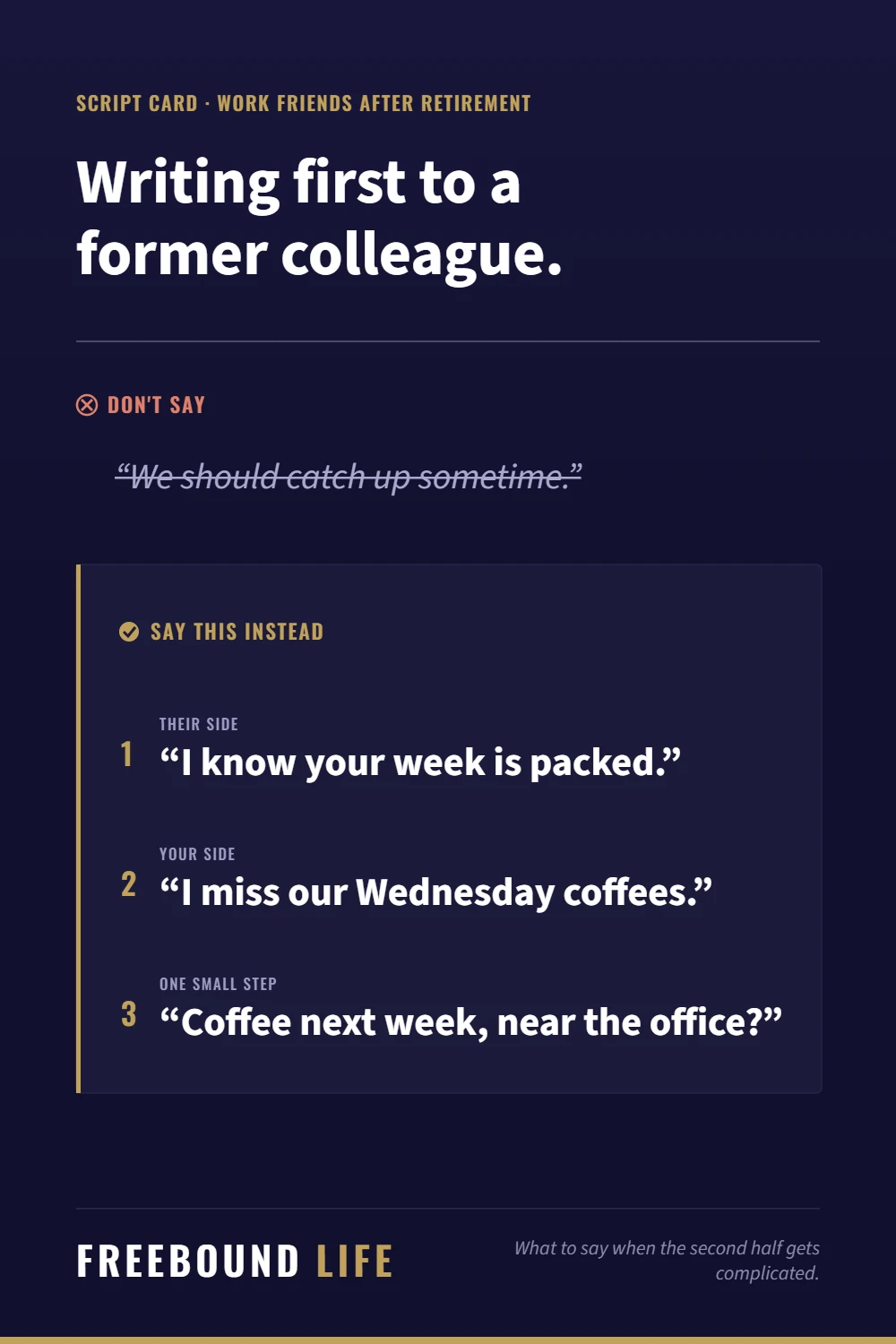
“We should catch up sometime.”
“Let me know if you ever need anything.”
“How’s everything at the old place?”
“Don’t let them work you too hard.”
None of them is wrong. Each one is warm, and each one quietly hands the next move to the person with less time.
Now the other phone. Your former colleague reads “we should catch up sometime” in the gap between two meetings. What they hear is roughly: here is a task with no date on it, from someone I already feel slightly guilty about. They mean the “definitely.” They also have a quarter-end, a new boss and a child with a science project due Thursday. “Soon” becomes a promise they keep meaning to keep.
Play it forward. In week seven nobody proposes a day, because proposing one feels like admitting you are the one with time on your hands. In month three the chat produces a birthday reminder; you send a cheerful line and get a heart back. By month six, the person you sat across from for eleven years has moved to the Denver office, and you hear about it from someone else at the supermarket.
“How’s everything at the old place?” has its own branch. It asks for a report. The kind ones send you a paragraph about the reorganization, you reply “Sounds about right,” and the friendship becomes a news service with one subscriber.
Why Nobody Writes First
At work, contact was arranged. Think of how an invoice moved through your old department: somebody raised it, somebody approved it, and the process told each person when it was their turn. Nobody had to decide to talk to the person in accounts. The workflow decided for them.
Work friendships ran the same way. The Monday status meeting, the shared deadline, the walk to the car park at the same time every evening: each one put you next to people without anyone having to ask. Retirement removes the workflow and keeps the people. The friendship is still there, waiting for an invitation that used to arrive by itself.
My own last day ended without any of that. At 6:42 p.m. on my last day in the office, I was still answering email. Nobody in the building knew it was my last day except me. I had expected something cinematic and got a normal Tuesday: the elevator arrived exactly when it always arrived.
I have thought about that evening more than I expected to. Nobody said goodbye because nobody knew to, so nothing was closed, and nothing was arranged either. There was no “let’s keep in touch” for anyone to half-mean. I’m not sure a goodbye would have changed what came after; plenty of people get a cake and a card and still drift. What I do understand now is that the next contact was always going to have to come from the one who left. The people still in the building were not being cold. They were being busy, on schedule, inside a process I had just walked out of.
Which Friendship Is This?
The first message depends on what kind of work friend this was. Most team chats hold three or four kinds.
The lunch friend. The friendship was the routine: the same table, the same complaint about the parking. Take the routine away and you are not sure what is left. Start with the routine itself; the soft version below was written for this one.
The one you actually talked to. One person, maybe two, who knew about your father’s surgery before HR did. This friendship deserves a direct sentence, and the firm version below is for them.
The whole team. You miss the noise of the room more than anyone in it. A group message will not bring the room back. Pick one person from it; the version with a smile usually suits that best.
The person you trained, or who trained you. There is often a loose end here: advice half-given, a career you were quietly watching. If months have already passed, use the long-gap version.
First Messages in Four Registers
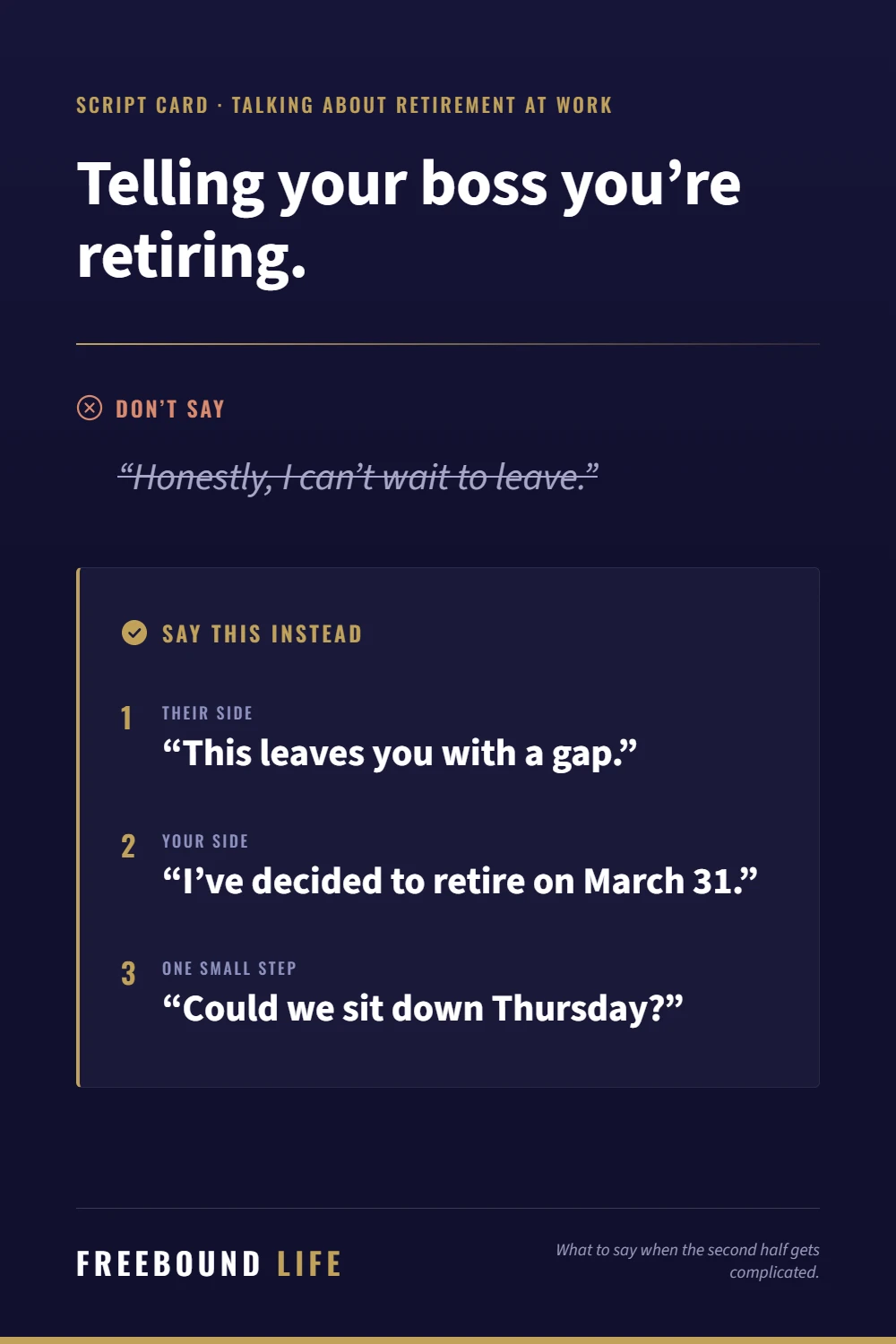
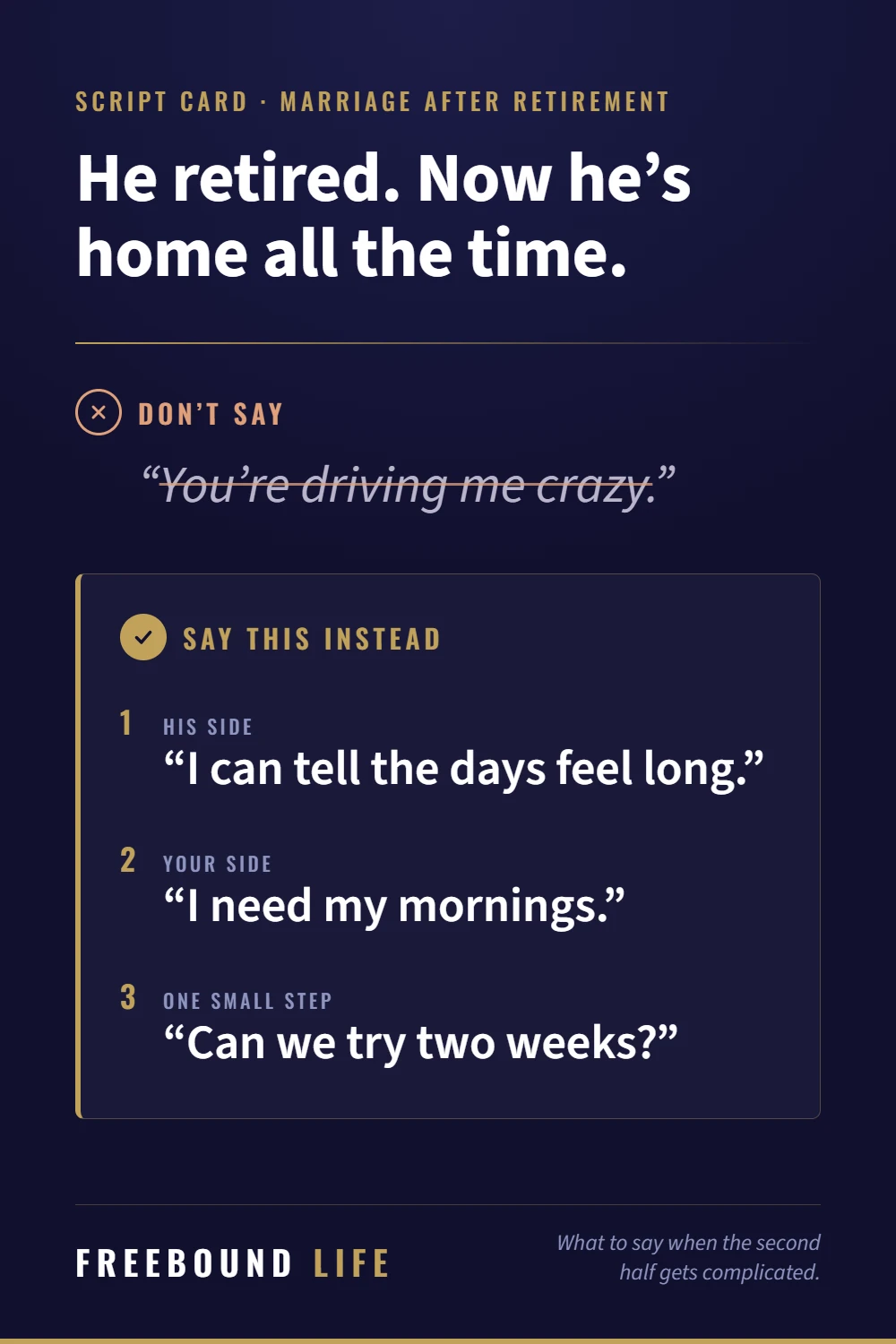
Every version below follows the same order, the one this site calls The Three-Sentence Rule: name their side first, then yours, then one small, concrete next step. Their side comes first because theirs is the busy one. The step has a day in it because a message without a day is a wish.
Soft, for the lunch friend:
“I know your week is packed.”
“I miss our Wednesday coffees more than I expected to.”
“Coffee next week, near the office?”
Firm, for the one you actually talked to:
“You’re busy, so I’ll keep this short.”
“You were the one I actually talked to, and I’d like to keep that.”
“Are you free on the 14th or the 21st?”
With a smile, for one person out of the whole team:
“I know you’re still fighting the expense app.”
“I’ve read the manual for my new kettle. Twice. I need grown-up conversation.”
“Coffee next week, my treat?”
When it has been a long time, for the person you trained or the one who trained you:
“It’s been a year, and that’s on me, not you.”
“I still think about how you ran the budget reviews.”
“Any week in March, wherever suits you. The coffee’s mine.”
Three things none of these messages contain: an apology longer than a clause, a report on your retirement, or a question that needs real thought to answer. The other person should be able to reply while the kettle boils.
Two Objections Worth Taking Seriously
“They were work friends. The work is over.” Half of that is right. Some of those friendships were made of the job, and when the job ended they had nothing left to stand on. The research further down suggests that is normal: as colleagues leave the close circle, family tends to take up more of it. But “work friend” describes where you met, not what the friendship was. One coffee will usually tell you which kind you had, and one coffee is cheap.
“If they wanted to see me, they’d ask.” They might. Some will. But compare the two diaries. They have a commute, a boss and a calendar run by other people. You have a Wednesday. Waiting to be asked hands the job to the person least able to do it, and then reads their silence as an answer.
When the Reply Comes Back Sideways
Most first messages get an answer. Not every answer is a yes.
If they say, “Yes, definitely, let’s do it soon,” reply: “Great. Does the 14th work, or is the 21st better?” Keep the dates in. “Soon” is where friendships go to be scheduled forever.
If they say, “Things are crazy right now,” reply: “Of course. I’ll try you again in March. No need to answer this one.” Then do try again in March. Put it in your calendar now, while you still feel brave.
If they say, “You must be loving retirement,” reply: “Mostly. I miss the people more than the work. Hence the coffee.” The longer answer to that question has its own page, The Reply I Kept Rereading.
If they say, “Come to drinks on Friday, everyone’s going,” reply: “I’d like that. Could we do a coffee too, just the two of us?” Group drinks are pleasant, and they are also how a whole team says goodbye to you slowly. The coffee is the friendship.
If they say nothing at all, wait two weeks. Silence in week one usually means a bad week, not a verdict. Then send one shorter message with no question in it: “No reply needed. Saw a terrible review of that expense app and thought of you.” After that, let it rest for a season. One unanswered message is ordinary. Two is enough. A third turns your kindness into an item on their to-do list.
Week Eight, Thursday the 14th, 8:15 a.m.
You get there first, because of course you do. They arrive at 8:19 with the lanyard still around their neck.
“Sorry. I meant to write back properly. It’s been a month.”
“You did write back. You said the 14th.”
“I did.” They sit down. “It’s strange without you there. Nobody argues with Finance anymore.”
“Somebody should.”
“Somebody should.”
For twenty minutes it is mostly news: the reorganization, the new boss who books meetings at 4:45, the expense app. Then there is a pause, and this is where most people reach for the bill. Stay in it.
“Can I say something slightly odd?” you say. “I know your weeks are full. I miss this more than the work.”
They wait.
“Could we make it a thing, once a month?”
They look at the lanyard, then at you. “First Thursday?”
“First Thursday.”
“I’ll forget.”
“I won’t. I’ll text you the Wednesday before.”
That is the whole follow-up, and it runs in the same order as the first message: their side, your side, one small step. The difference is that the step now repeats without anyone having to ask again. By hand, you have rebuilt the one thing the office used to supply: a reason to be in the same place.
Month Three, the Wednesday Before
The text you promised: “Tomorrow, 8:15, same place?” The reply comes in four minutes: “Yes. I have gossip.”
Not every friendship gets this far. Say you wrote to four people in week six. One never answered either message. One said yes to drinks and has not yet said yes to coffee. One is the first-Thursday coffee. And one, the person you trained, answered your long-gap message with three paragraphs about a job offer they could not decide on, which you are still turning over on the walk home.
That is not a bad result. It is a fairly typical one.
April, Scrolling Past the Team Chat
Go back to the team chat. It is further down the list now, below a cycling club and your sister. The last message in it is a photo of a leaving cake for somebody else.
Scroll back up to the top. There are two names from the old building there, in the part of the list that moves every week. That is what the message in week six was for. Not the room, which was always going to go. Two people, near the top of your phone, in April.
Never Send This One
“I guess everyone’s too busy for me now.”
It turns a quiet fade into a quarrel, and it makes the other person defend their calendar instead of opening it.
What Researchers Agree On, and Where They Split
Researchers who follow people across the retirement line agree on one thing: colleagues are the first to go. They disagree about what happens to everyone else.
The clearest picture of who goes first comes from a study of 12,885 people aged 50 to 79 in 14 European countries, surveyed three to five years apart in the Survey of Health, Ageing and Retirement in Europe. Minna Tuominen and colleagues found that the most consistent change was a decrease in colleagues within the close network. The number of relatives in people’s networks, and how often they were in touch with others overall, stayed fairly stable.
A Finnish study shows the size of it. Researchers followed 2,319 people from the Finnish Retirement and Aging study, 84 percent of them women, with a mean age of 63.2. Before retirement they listed 21.6 ties on average. During the retirement transition that number fell by about one person, mostly from the outer circle of less close ties, and it did not keep falling afterward. The inner and middle circles, the people they felt closest to, showed no decrease.
That is the reassuring half. The less reassuring half comes from Axel Börsch-Supan and Morten Schuth, who report that social contacts, especially with friends, decline gradually after retirement, and faster when retirement comes early.
A third team, Simona Comi, Elena Cottini and Claudio Lucifora, worked with the same European survey and used differences in retirement-eligibility ages to separate what retirement itself does. They found that retirement changes the composition of people’s networks: family takes a larger share, colleagues and friends a smaller one, and there is no effect on the network’s size.
So does the circle shrink, or does it only reshuffle? The researchers have not settled it, and I would rather tell you that than pretend otherwise. What all of them agree on is the part that matters here. The colleagues go first, from the edge, in the stretch right after leaving, unless somebody does something about it. And the somebody with the most room to act is the one who left.
Work Friends After Retirement: Three Questions
Why do I miss my old coworkers so much?
Because they were the people you saw most without having to arrange it, and retirement removes that arrangement all at once. Comi and colleagues also found a difference between men and women: in their data, women mainly lost a share of friends from their networks, and men mainly a share of colleagues. Missing your coworkers is not a sign the friendships were shallow. It is a sign they were frequent.
Is it normal to feel lost after retirement?
It is common. In the European analysis above, people’s satisfaction with their close network held fairly steady through retirement even as colleagues left it, and the authors describe the changes as mostly positive overall. A lost feeling in the first months often eases as the week finds a new shape. If it lasts, or starts to affect your sleep, mood or health, talk to your doctor, as you would about any lasting change.
How do I make friends after retirement?
Start with the friends you already have. Comi and colleagues found that the ties which survive retirement tend to become more intense, and Tuominen’s team writes that as colleague ties fade, they are made up for by other close connections, by more social participation, or both. For new friendships, the lesson from the coffee holds: choose something that repeats on a schedule, such as a class, a club or a standing volunteer shift, so the meeting no longer depends on anyone asking.
Keep This Line in Your Drafts
Whoever has the free afternoon writes first.
If there is a name in your phone you keep scrolling past, the Ask Ian page is a good place to draft your first line to them.
Get The Midlife Reinvention Blueprint
The free 20-page workbook for redesigning your career, money, and purpose after 40 — the four-pillar framework, a personal audit, the five defining questions, and a 90-day roadmap, including the worksheets for your freedom and coast numbers.
Read next → The Reply I Kept Rereading — the other half of this conversation: what to answer when they write first.
Most of the frameworks here come with a scored instrument: a worksheet you fill in rather than read. Reading one is quick. Filling one in is the part that changes something.
Open the pack →