In 1927 a seventeen-year-old from Vienna took a job as a trainee in a cotton-export firm in Hamburg. The work started at half past seven, finished at four, and taught him, by his own account, very little. What it left him was his evenings. Once a week he spent one of them at the opera.
One night the opera was Verdi’s Falstaff, the last one Verdi wrote. It was rarely staged in those years, because singers and audiences both found it too difficult. The trainee was overwhelmed. When he looked into it afterward, he found that this opera, so full of gaiety and appetite for life, had been written by a man of eighty. To a boy of seventeen, eighty was barely a real number.
The trainee was Peter Drucker. Seventy-two years later, at eighty-nine, he published the clearest instructions anyone has written about the second half of a working life, in a Harvard Business Review essay called Managing Oneself. They are much less about retirement than people expect. Drucker placed the start of the second half at about forty-five, decades before any farewell speech, and he thought it was settled by what a person had already started before getting there.
What he decided after that evening, he was still living by seventy years later. This is what he understood, where the idea came from, and the one question his essay leaves you holding.
The Words He Found Afterward
The opera was only half of it. The other half was something Drucker read a little later. Verdi had been asked why, already famous and counted among the great composers of his century, he had taken on one more opera at that age, and an exceptionally demanding one. Verdi answered that he had chased perfection all his life as a musician and never caught it, and then added: “I surely had an obligation to make one more try.”
Drucker told the story himself in a 1997 essay for Inc., My Life as a Knowledge Worker, in which he listed seven experiences that taught him how to grow and age. Verdi is the first. He wrote that he resolved, at seventeen, to make Verdi’s words his guide: if he ever reached an advanced age, he would not give up but keep going, and in the meantime he would aim at a standard he knew he would never fully reach.
He also recorded a less flattering comparison. At eighteen, Verdi was already a seasoned musician. At the same age Drucker had no idea what he would become, beyond a growing certainty that it would not be exporting cotton textiles. That is roughly where most careers start, with one firm conclusion and it is about the wrong job.
The plain point of the evening is this: Drucker learned at seventeen that the late years can hold the most demanding work of a life, and that they only do so for people who never stopped working at something. A man of eighty writing a comic opera is, among other things, a man who has declined to be told what his age is for.
The Age Nobody Plans For
Seventy years after Hamburg, Drucker put the second half on the calendar, and he put it much earlier than most people do.
His essay opens with a warning that most of us will have to stay alert and engaged through a working life of some fifty years, which means knowing how and when to change the work we do. Then, near the end, it gets specific. For most of history, Drucker wrote, work meant manual labor, and anyone who survived forty years in a mill or on a railroad was glad to spend what remained doing nothing. Knowledge work broke that arrangement. People who work with their heads are not used up after forty years; they are bored.
He was precise about when the boredom arrives. By forty-five, he observed, most executives have reached the peak of their careers and they know it. After twenty years of much the same work they are very good at it, and they are no longer learning from it, contributing anything new through it, or finding it a challenge. They still have another twenty or twenty-five years of work in front of them. The midlife crisis people talk about, in his reading, is mostly that: boredom at the top of a long competence.
This is an unflattering thing to be told at the peak of a career, which may be why so few people pass it on.
Put plainly, the second half arrives as a long stretch of work you are excellent at and no longer growing in, years before anyone mentions retirement. If that flatness sounds familiar, the way high achievers lose purpose describes what happens when a goal you borrowed from someone else finally runs out. Drucker’s contribution is narrower and more useful. He gives the timetable.
Ten Hours a Week, Somewhere Else
Drucker’s answer to the boredom was what he called a second career, and he described three ways into one.
The first is simply to start it. Often that means nothing more dramatic than moving from one kind of organization to another, his example being the divisional controller at a large corporation who becomes the controller of a medium-sized hospital. Sometimes it means a different line of work entirely: the executive who enters the ministry at forty-five, the middle manager who leaves after twenty years for law school and a small-town practice.
The second is a parallel career. The person stays in the work they have been doing, full-time, part-time or as a consultant, and adds a second role, usually in a nonprofit, that takes about another ten hours a week. Drucker’s list is deliberately ordinary: running a church’s administration, chairing the local Girl Scouts council, sitting on the school board, working as a children’s librarian.
The third is the social entrepreneur, someone who still loves the first career but is no longer stretched by it, gives it gradually less time, and builds something else beside it. Drucker’s example was his friend Bob Buford, who kept running a successful television company while founding and building nonprofits.
Then he made a prediction that has aged well. The people who actively manage their second half, he thought, may always be a minority. The majority would retire on the job and count the years until the real retirement arrived. Retiring on the job requires no paperwork, which is a large part of its appeal.
The Lawyer Who Started at Thirty-Five
The most important sentence in the section is short. There is one prerequisite for managing the second half of your life, Drucker wrote, and it is this: “You must begin long before you enter it.”
He knew it partly because he had been wrong. Some thirty years before the essay, when it first became clear that working lives were lengthening fast, he and many other observers expected retired people to pour into volunteer work. It did not happen. His conclusion was blunt: people who have not started volunteering by forty or so do not start after sixty. A correction like that is rare in a management essay, and it is the most persuasive paragraph in this one.
His example is a lawyer, the counsel to a large corporation. Around thirty-five he began doing volunteer legal work for schools. At forty he was elected to the school board. At fifty, having made a fortune, he started his own enterprise to build and run model schools, while still working nearly full-time as lead counsel at the company he had helped found. Fifteen years passed between the first piece of volunteer work and the thing that would make a good obituary.
The plain lesson is about sequence. By the time the second half is visible, its ingredients have to exist already, because the energy and the contacts and the standing come from years of small involvement nobody was paying attention to.
This is close to an idea already on this site, and the difference matters. Building a second career after 40 sets out the Overlap Method: grow the next career beside the first until it can stand on its own, so you never leap. That is a bridge, built for the crossing, and Drucker’s lawyer was never planning to cross: he kept the first job. The second thing had a different purpose.
The Engineer Passed Over at Forty-Five
Drucker gives a second reason to start early, and it is the one most summaries leave out.
Nobody, he wrote, lives very long without a serious setback in life or work. He names them flatly: the competent engineer who is passed over for promotion at forty-five; the professor who realizes at forty-two that the post at a major university is never going to come, however qualified she is; a marriage that ends; a child who dies. At such times, he argued, a second major interest, something more than a hobby, can make all the difference. The engineer now knows he has not been a great success at work, and as treasurer of his church he is one.
That phrase, the second major interest, is the noun this piece claims, so it needs a boundary. It is not the next career, which is what the Overlap Method builds. It is not a hobby, which you do for the pleasure of it and which nobody depends on. And it is not a retirement plan, which waits for a date. A second major interest is a second place where your work counts, where people rely on you and know you for it, running alongside the main job while the main job is still going well.
Church treasurer is not a title anyone lists on a profile. For the engineer, it may be the line of the week that holds the rest up.
Drucker tied this to something larger. In a society that expects everyone to succeed, he observed, most people will at best avoid failure, because wherever there is success there is also failure. So it matters, for a person and for their family, to have an area where they contribute and are someone. Feeling useless after retirement is what the absence of that area feels like once the title is gone. The second major interest is what you build so that the day the title goes is not the first time you look for one.
What Verdi Had Behind Him
Go back to the opera house for a moment, because the story is usually told the wrong way round.
Falstaff gets remembered as a late burst, an old man’s surprise. Drucker’s own account points somewhere else. Verdi was already a seasoned musician by the time he was eighteen. The comic masterpiece at eighty was the latest piece of work in a life that had never put the work down, which makes it something closer to a continuation than a comeback.
That is the understanding underneath Managing Oneself. The second half of a working life is not a room you walk into at a certain age. It is assembled, quietly and in advance, out of hours the first half can spare: ten a week on a school board, an unpaid afternoon of legal work, a role nobody asked you to take.
Drucker lived the same way. In the same essay he recalls doing well as a young investment banker in London in the mid-1930s, in work that suited his strengths, and quitting anyway, with no money and no other job in sight, because he had realized that people mattered more to him than managing assets. He also describes a habit he kept for fifteen to twenty years by the time he wrote it down: whenever he made a key decision, he wrote down what he expected to happen, and nine or twelve months later he compared the result with the note. He says it surprised him every time.
That habit and the second major interest do the same job. Both give you information about yourself that the main job, at its peak, has stopped supplying.
One Question for an Ordinary Weeknight
Drucker’s essay is full of questions, but the second-half section leaves one in particular, and it is worth asking on a normal Tuesday rather than at a milestone:
If your main work went badly next year, where would people still rely on you?
Answer it with a place and a day of the week, if you can.
If the answer is a specific room on a specific evening, a board you sit on, a group you run, people who would notice if you stopped turning up, you already have a second major interest. Your job is to keep it serious, which in Drucker’s terms means treating it as more than a hobby.
If the answer is your family, that is real and it is not what he meant. He was explicit that a family can break up and that the outside activity is where a community remains when it does.
If the answer is that you would work something out, that is the answer of a person planning to begin at sixty. On Drucker’s own evidence, that is the start that rarely happens.
“I don’t have ten spare hours. I have a full job, a teenager who needs driving, and a parent who calls at nine.” That is true for many people at forty-five, and it is worth saying exactly how far it is true. Drucker’s lawyer also kept a nearly full-time job. What he did not do was wait until the schedule cleared. The first commitment was small enough to fit. If the hours are the problem, designing your ideal day is the place to find them, and the transferable skills audit shows which of your abilities would count in a room that has never seen your job title.
This is the ninth stop on The Second Half Path: finding purpose after 40 → why high achievers lose purpose → the midlife reset → identity crisis after success → designing your ideal day → reinventing yourself after 50 → feeling useless after retirement → the retirement party question → you are here.
Get The Midlife Reinvention Blueprint
The free 20-page workbook for redesigning your career, money, and purpose after 40 — the four-pillar framework, a personal audit, the five defining questions, and a 90-day roadmap, including the worksheets for your freedom and coast numbers.
Why This Painting
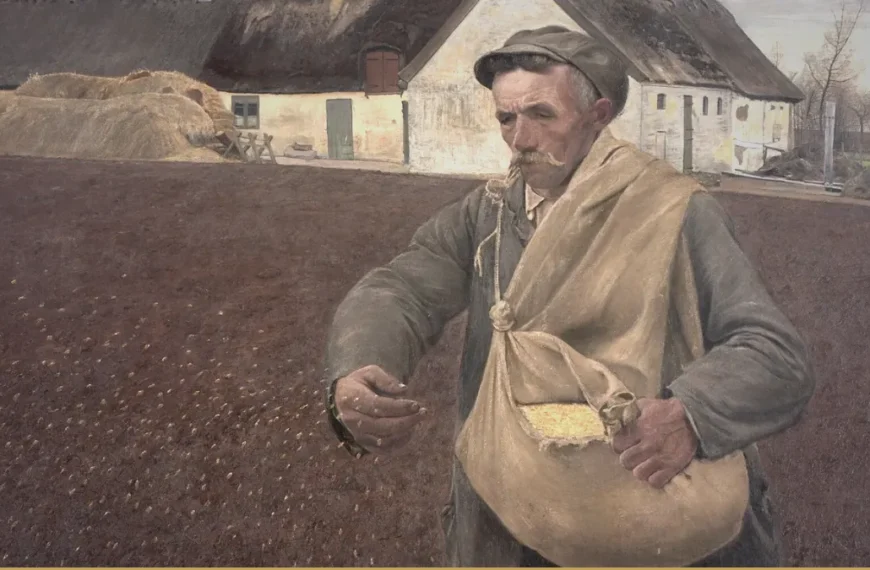
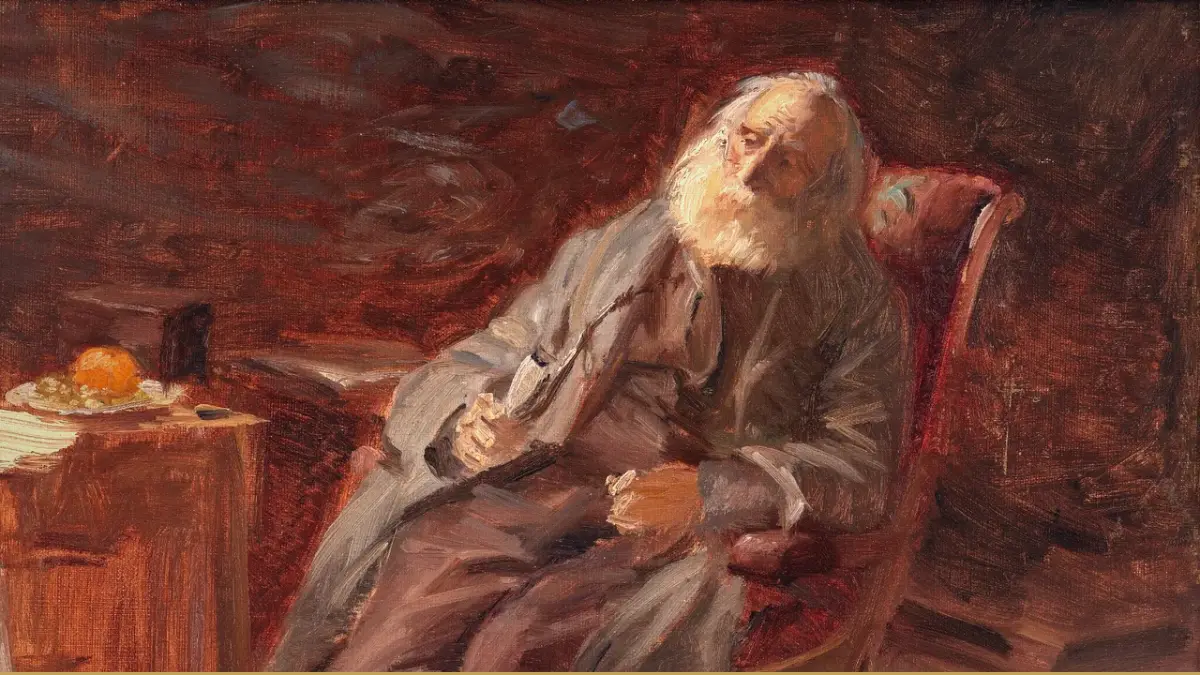
This is not Peter Drucker. It is the Danish landscape painter Vilhelm Kyhn, painted in 1903 by Anna Ancher, who had once been one of his students. Kyhn was eighty-four and died that year. For three decades he had also run a painting school for women, a second job beside his own canvases. Ancher put him in a studio chair with his pipe, and left an easel standing at the edge of the frame.
The Rule He Kept From Hamburg
The trainee who sat through Falstaff in 1927 kept his resolution. Managing Oneself appeared in 1999, when Drucker was eighty-nine, older than Verdi had been when he wrote the opera that started it. Read with that in mind, the essay is his own version of one more try: a man past the age that once seemed impossible, still working, telling people half his age to start sooner than they think.
His advice comes down to something plain. The second half of a working life is mostly made of things begun in the first, on ordinary evenings, while the main work was still going well and nobody was watching.
The second half is built in hours the first half could spare.
Read next → How to build a second career after 40
Most of the frameworks here come with a scored instrument: a worksheet you fill in rather than read. Reading one is quick. Filling one in is the part that changes something.
Open the pack →