The first sign was my phone.
Or rather, the absence of it.
For most of my working life, my days arrived already occupied. Before I had finished breakfast there were emails waiting: questions needing answers, decisions needing approval, problems needing attention. Somewhere, someone always needed something.
After about thirty years, that stopped feeling like part of the job. It felt like weather. I stopped noticing it.
Then one day it stopped.
Already Occupied
When people talk about retirement, they usually list the obvious changes. No alarm clock. No commute. No meetings. No deadlines.
Those changes are real. They were not the ones that surprised me.
The surprise was quieter. For decades, being useful had been built into the structure of an ordinary day. My calendar existed because people expected things from me. My inbox existed because people needed answers. My phone rang because something was waiting at the other end of it.
The work could be stressful, demanding, occasionally exhausting. It also supplied something I did not fully appreciate at the time: evidence. A steady stream of it. Someone wants your opinion. Someone needs your expertise. Someone forwards a problem. Someone invites you into a meeting. Each of those small interruptions carries the same message, and after enough years you stop hearing the message and only hear the interruptions.
You are needed.
Most professionals never examine this. We are too busy taking part in the machine to look at it.
A Day Without a Ring
The message did not end on my last day. That is the part I had not expected.
It faded. The emails became fewer. The calls came less often. The requests slowed, then thinned out. The meetings went on without me, the projects moved forward, the organization adapted, and the world kept working, exactly as it should. Even the calls that still came were different; one of them, from a former colleague, became the call I expected to be urgent.
Then, several months after I retired, there was a day when my phone did not ring at all. Not once, from morning to night.
I had assumed the quiet would feel good. It felt unfamiliar instead.
Not painful. Not even unpleasant. Just unfamiliar, like walking into a room where a sound you have heard your whole life has suddenly disappeared. At first the silence feels wrong, not because silence is bad, but because you have forgotten it exists.
Everyone Around Me Was Busy
Around the same time, I was sitting in a café in Seoul. Everyone around me was busy. Laptops open. Meetings. Phone calls.
Not long before, that seat had been mine.
That day, for the first time, I felt like an observer.
It is an odd position for someone who spent a career in the middle of things. From the outside, you can finally see the machine, and you can see that it no longer requires your participation.
At first I read the feeling wrongly. I thought I missed being needed. Later I realized I missed being familiar. For about thirty years, usefulness had given my days their structure. It told me where to focus, what mattered, what deserved my attention. Without it, I had to answer those questions myself.
That was the real adjustment, and it went slowly. Retirement removes certain illusions, but not all at once. It shows you, a little at a time, how much of your identity was attached to your role. How much confidence came from competence. How much certainty came from routine. How much self-worth came from being useful.
These are uncomfortable discoveries. They are also useful ones.
Useful, in Another Shape
The lesson arrived later, on an afternoon with nothing scheduled. Somewhere in it I stopped thinking about work entirely. Not on purpose. It simply happened, and for the first time I saw the quiet differently.
Every request had claimed attention. Every responsibility had occupied space. Every obligation had taken a little flexibility with it. The things that made me useful had also made me unavailable.
To myself.
This is not an argument against responsibility. Contribution matters. Helping people matters. Being useful matters. The mistake is assuming usefulness can only arrive through professional demand.
Nobody needed my quarterly forecasts anymore. Nobody needed my attendance in meetings or my approval on a document. But people still needed conversation, perspective, encouragement, experience. Presence.
There is a study I keep coming back to. Researchers following the MacArthur Study of Successful Aging asked 1,030 people aged 70 to 79 how often they felt useful to their family and friends, then followed them for seven years. The few who answered never or rarely, about one in seventeen, had roughly three times the odds of having died by the end of that period compared with those who said frequently, even after the researchers adjusted for health and circumstances at the start (Gruenewald and colleagues, 2007). A study like that cannot prove which way the arrow points. But look at what the question asked. It did not ask about work. It asked about family and friends.
The role disappeared. The usefulness did not; it changed shape.
That distinction took me a long time to understand. For years I had confused my function with my identity. The organization needed the function. The people around me knew the person. One can disappear in a single month. The other usually stays.
This is the thirteenth stop on The Second Half Path: finding purpose after 40 → why high achievers lose purpose → the midlife reset → identity crisis after success → designing your ideal day → reinventing yourself after 50 → feeling useless after retirement → the retirement party question → what Peter Drucker understood → the call I expected to be urgent → halfway through my career advice → returning to Seoul → you are here.
Get The Midlife Reinvention Blueprint
The free 20-page workbook for redesigning your career, money, and purpose after 40 — the four-pillar framework, a personal audit, the five defining questions, and a 90-day roadmap, including the worksheets for your freedom and coast numbers.
Why This Painting
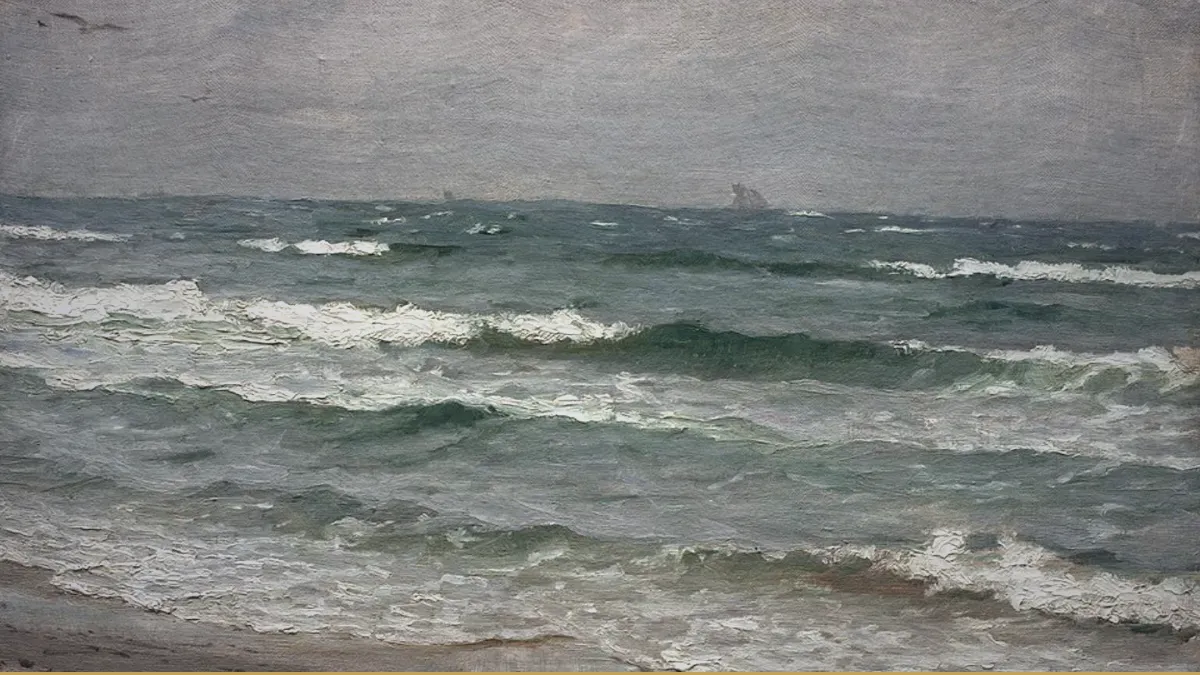
P.S. Krøyer painted this sea study at Skagen, at the northern tip of Denmark, and marked it with a single day: 14 July 1882. It is a small canvas, about a third of a meter tall, and the waves take up most of it. Far out on the horizon, small enough to miss, a ship is under sail, holding its course whether or not anyone on the beach is watching.
No Date on the Last One
Krøyer could put a date on his day. I cannot put one on mine. Somewhere in those first months there was a final question that only I could answer, and if it came, it came looking exactly like all the others.
I used to think that was the sad part of the story. I no longer do. A need that ends without ceremony was never the whole of what I had to offer. It was the part an organization could schedule. The rest of it was never on anyone’s calendar, which is exactly why it is still here.
The first question built my career: who needs me today? The second is the one I ask now: how do I want to spend today?
If I could hand one sentence back to the man reading emails before breakfast, it would be this.
The need was always theirs to end; the person it called on was always mine to keep.
If you have a sentence like that, the one you rehearsed in the car and never said, leave a comment and send it to me. Nobody here will grade it.
Read next → Why feeling useless hits hardest when you need the money least
Most of the frameworks here come with a scored instrument: a worksheet you fill in rather than read. Reading one is quick. Filling one in is the part that changes something.
Open the pack →