Three or four months after I retired, people started checking in on WhatsApp. A former junior colleague. People I had worked beside for years. Friends from school, some a year or two ahead of me, some behind. They all asked some version of the same question: so, how is retirement?
I gave every one of them the same answer. “I’m doing this and that. Keeping myself busy.”
If you are retired, or close to it, you have probably typed that sentence too. It is the most common answer to the most common question of the second half, and it sounds completely harmless. It took me a few seconds to write; it took much longer, and a series of conversations with a neighbor about the stock market, to understand what I had actually been saying.
Three or Four Months In
Before you read any further, try something. Open your own messages and search for the word busy.
If you have left work in the last year or two, I would be surprised if it is not there. Keeping busy. Busier than ever. Never been so busy. Mine was there several times, in nearly identical form, sent to people who knew me well enough to deserve a better answer.
Each word of my reply was true. I was doing things, plenty of them. Nobody reading it would have guessed anything was missing, and I would not have admitted that anything was.
Then I did something I had never done with a text message in my working life. I read my own reply again. And again. Not the question, which I had understood at once. My answer. Over the next several days I kept coming back to it in the gaps of the day, the way you return to a clause in a contract that is technically correct and still bothers you.
In three decades of work I must have sent tens of thousands of replies. I cannot remember rereading a single one to find out what I meant.
The Sentence and the Silence Behind It
Here is what I got wrong, in plain words.
I believed my reply was an answer to their question. It was actually a way of not hearing mine.
Their question was simple: how are you? Mine was harder, and I had not said it out loud even to myself. Now that nobody needs me at nine o’clock, what is this time for?
What the reply left out was that I felt empty, and a little deflated. Underneath the activity there was an old and very loud instinct telling me I had to be doing something, preferably something that improved me. I had carried that instinct through my whole career. Retirement had not switched it off. It had only removed the place where it used to go.
So the instinct did what instincts do. It found the nearest thing it could measure, which was activity, and it reported that. Activity can be counted. Purpose cannot. I had answered a question about my life with a list.
That pattern, answering the question you cannot measure with something you can, turns out to be the thread of this whole story. I did not see it yet. It took a neighbor to show me.
The Most Popular Answer Since 1986
My sentence is not original. It is not even close.
In 1986, a sociologist named David Ekerdt published a paper in The Gerontologist about the way retired people talk about their days, a way of talking that, as he put it, “emphasizes the importance of being busy” (Ekerdt, 1986). He noticed how often retirees told people they had a lot to keep them busy, or that they were as busy as ever.
In plain terms, his explanation goes like this. Most of us spend our working lives believing that hard work makes us good people. When the work stops, that belief does not stop with it. It needs somewhere to go, so it attaches itself to whatever is left: errands, projects, the calendar. Ekerdt called this the busy ethic. He argued it does a real job. It makes free time feel earned, and it protects retired people from the suspicion that they have simply wound down.
In other words, I had not invented a cover story. I had picked up a script that people in my position have been reading from for at least forty years.
The numbers say something about why the script is needed. According to the American Time Use Survey’s 2025 results, adults aged 75 and over spent an average of 7.4 hours a day in leisure and sports activities, against 3.9 hours for people aged 35 to 44. The same survey found that the share of people who spent any time socializing and communicating on an average day fell from 38 percent in 2015 to 30 percent in 2025 (BLS, 2026).
Put those together and you get the shape of the problem. Later life gives you far more free hours, at the same moment the culture around you is spending less time actually talking. Busy is the word that fills the gap between those two facts.
Which Reply Is Yours?
Keeping busy is the classic, but it is not the only version. There are at least four, and most of us rotate between them depending on who is asking.
The Busy Report. “Keeping myself busy.” Mine. It reports activity, closes the topic, and lets everyone move on. What it hides: whether any of the activity matters to you.
The Travel Brochure. A list of trips, taken or booked. It is the busy report with photographs. What it hides: what an ordinary Wednesday at home feels like.
The Market Update. The conversation moves quickly to stocks, property and interest rates. It feels serious and adult, and it is the one that caught me out later. What it hides: the question that has no ticker symbol.
The Boomerang. “Oh, you know. How about you?” It hands the question straight back. What it hides: everything, very politely.
None of these is a lie. Each one is an answer to a question nobody asked, given so that the question somebody did ask can be skipped.
The Neighbor by the Elevator
Later, I met someone who made the Market Update impossible to ignore.
I kept running into the same man by the elevator and in the parking garage. He was about my age, and he had retired at about the same time I had. In a building, that is enough of a coincidence to start a friendship, and we got close quickly.
Talking to him was easier than most conversations I had at work. At work, a conversation always carries a little weight: who reports to whom, who needs what by Friday. Here there was none of that. Our lives look alike, and so, roughly, do our circumstances. There is a particular relief in talking to someone who needs nothing explained.
And we did talk about the real thing, at least at first. The emptiness. How to fill days that had become free whether we had asked for that or not. Whether we were now supposed to go out and acquire a hobby, the way you might acquire a gym membership in January.
Then, every time, the talk slid toward money.
Stocks, property, exchange rates. Markets that rise and fall sharply enough to make anyone nervous. And under all of it, the plain fact that we both expected to live at least another twenty or thirty years, and the question of how to stay financially free for all of them. It was a natural conversation. It was also, underneath, a worried one. I suspect we both knew that, and neither of us said it.
We are not unusual. A Dutch research team followed more than five thousand people through the NIDI Pension Panel Study across three waves between 2015 and 2023. They found that retirement was linked mainly to more contact with neighbors and friends, and they suggest that retirees partly replace the conversations they lose at work by seeing former colleagues outside work and by spending more time with the people who live nearby (Bosma, Henkens and van Solinge, 2025).
So the man by the elevator was not a coincidence. He was where some of my working life’s conversations had gone. And the first thing those conversations did was the same thing my WhatsApp reply had done.
Why We Kept Ending Up at Money
Here is what I eventually noticed about those talks.
We always started with the question that has no number: what these days are for, whether to take up something new. Then, within minutes, we were on the subject that has nothing but numbers. A share price. A rate. A sum that has to last.
That is the same move my reply made. Busy is a number too, really: a count of things done. A portfolio is a number. Both feel solid because you can measure them. What we had actually come to talk about, how to live inside all this new time, cannot be measured, so the conversation kept drifting to the part that could.
Someone will push back here, and they would be partly right. “Money worry is not a distraction. Markets really do swing. Twenty or thirty years really is a long time to fund.”
All of that is true, and I am not pretending the money question is imaginary. It came up in those conversations because it is real, and it deserves a careful answer. If you want to put an actual number on it, there is a Freedom Number calculator on this site for exactly that.
But notice what happened in our conversations. The money talk never came back around to the hobby question. It replaced it. The measurable worry pushed the unmeasurable one off the table, every time, and we both let it.
Four Thoughts That Would Not Leave
After those conversations, four thoughts stayed with me. I have not managed to separate them since, so I will give them to you together.
The first was relief. I was not the only one. Someone with a life very like mine was carrying the same quiet worry.
The second was harder. We had worked for decades partly in order to be free. If our free time was still mostly spent talking about markets, what exactly was the freedom we had wanted?
The third was that life after work is more complicated than I had planned for. I had prepared for the calendar and not much else.
The fourth was my old reply. Keeping myself busy. In those conversations I finally heard it properly. I had more control over my time than at any point in my adult life, and I did not yet know what the time was for. The busy report and the market update were the same answer in different clothes. Both let me talk about something countable instead.
In Fairness to Busy
A second objection deserves a hearing. “There is nothing wrong with keeping busy. Busy people stay healthy, stay sharp and stay in touch.”
I agree with most of that. Ekerdt did not describe the busy ethic as a mistake. He described it as useful, a way of giving retirement a shape and protecting retired people from being written off. Much of what kept me busy in those months was worth doing, and I would do it again.
So the problem was never the activity. It was the reply. Keeping busy told my friends what I was doing and nothing about how I was, and it gave them no way in. A person asking how you are is offering you a door; I kept answering with a timetable.
What to Say the Next Time Someone Asks
Here are three replies I would send now. All of them are short enough for WhatsApp, and all of them are true.
Honest. “Honestly? Some days are full and some feel strangely empty. I’m still working out what this time is for. How about you?”
Brief. “Busy, but I’m still figuring out which of it matters. Coffee soon?”
With a smile. “I’ve reorganized one cupboard three times. So: thriving. Tell me about you.”
If they reply “Must be nice.”, you can say: “Some days it is. Some days I miss being needed at nine.” If they ask “So what do you actually do all day?”, try: “Less than you’d think, and I’m learning to be fine with that.” And if they do not reply at all, that is fine too. You have still said something true, which is more than my old reply did.
Before answering, I now ask myself three quick questions:
- Am I busy because I enjoy what I am doing, or because an empty day seems to need an explanation? If it is the second, the busy ethic is talking.
- Who do I genuinely want more time with? Who I would choose if nobody were counting.
- What would make an ordinary Tuesday feel worthwhile? A holiday is easy; I mean a Tuesday.
I did not send any of those replies at the time. What the emptiness eventually turned into was this: the old instinct to keep improving finally found somewhere to go. It went into writing, and then into this site. The conversations with my neighbor are the reason this particular piece exists.
This is the newest stop on The Second Half Path: finding purpose after 40 → identity crisis after success → reinventing your life after 40 → designing your ideal day → feeling useless after retirement → the retirement party question → what Peter Drucker understood → the call I expected to be urgent → halfway through my career advice → returning to Seoul → the last time they needed me → three words in the break room → you are here.
Get The Midlife Reinvention Blueprint
The free 20-page workbook for redesigning your career, money, and purpose after 40 — the four-pillar framework, a personal audit, the five defining questions, and a 90-day roadmap, including the worksheets for your freedom and coast numbers.
Why This Painting
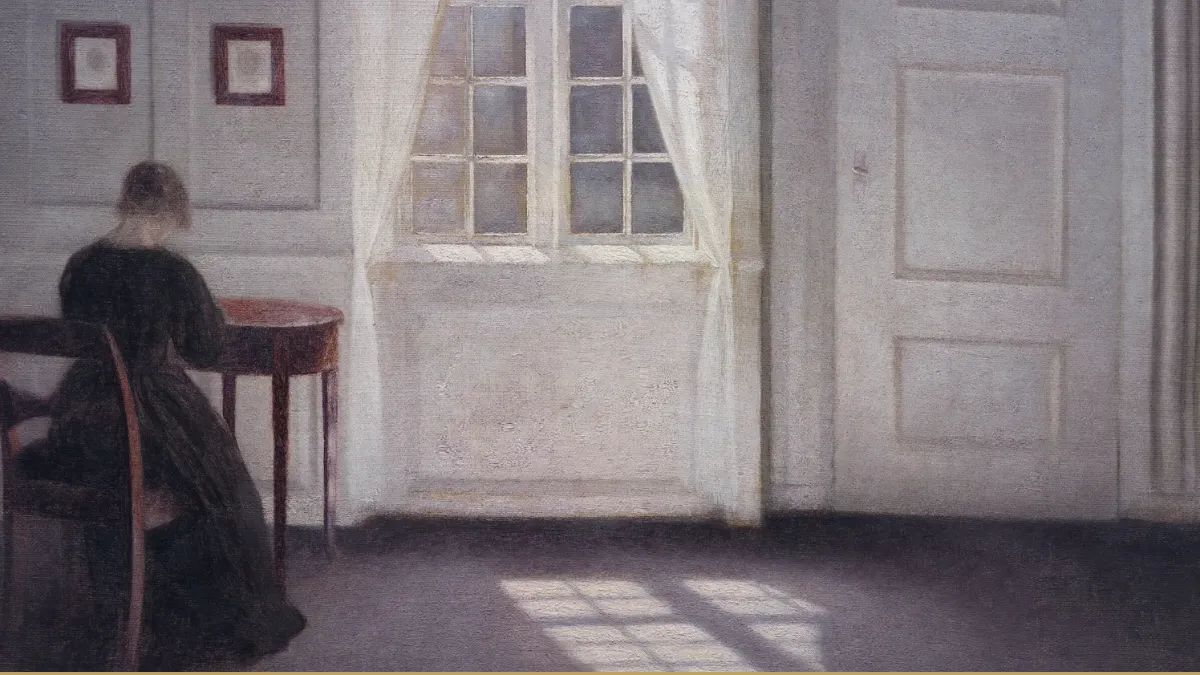
Vilhelm Hammershøi painted Stue i Strandgade med solskin på gulvet, a room in Strandgade with sunlight on the floor, in 1901 (SMK, the National Gallery of Denmark, KMS3696). A woman sits with her back to us at a small table. There is a tall window and a closed white door. The museum notes that around 66 of his interiors come from the same apartment, at Strandgade 30. The brightest thing in this room is a patch of sun that nobody arranged.
The Answer I Give Now
I still say keeping busy sometimes. It is quick and polite, and on some days it is the whole truth.
But I no longer treat it as an answer. I treat it as the first line of one. The rest is what I left out on WhatsApp and found again with a neighbor by the elevator: the time is mine now, some days it feels empty, the money question has not gone away, and I am still learning what all this freedom is for.
That is a longer reply, and it starts a conversation instead of closing one.
Busy is an answer about the calendar; the question was about the person.
What do you say when an old colleague asks how retirement is going? The Ask Ian page takes the honest version, unedited.
Read next → The call I expected to be urgent
Most of the frameworks here come with a scored instrument: a worksheet you fill in rather than read. Reading one is quick. Filling one in is the part that changes something.
Open the pack →